International Women's Day Assembly
March 9, 2026
Sunday 8 March marked International Women's Day. A day to celebrate the achievements women have made in the fight for equality, to reflect on the journey that brought us here, and to look ahead at how we can empower the next generation. We have come a long way since the suffragettes marched and campaigned in the early 20th century. But we still have a long way to go.
In assemblies like this, we often shine a spotlight on inspirational women, changemakers, trailblazers and revolutionaries. But today, I want to step back and look at statistics that explore the bigger picture, the everyday reality for women in the UK.
We often use statistics to try to ground ideas in reality, and when it comes to women's equality, there is no shortage of figures to choose from. But statistics can feel cold and distant, disconnected from the real people behind them.
So today, rather than just reading numbers off a page, we are going to bring them to life.
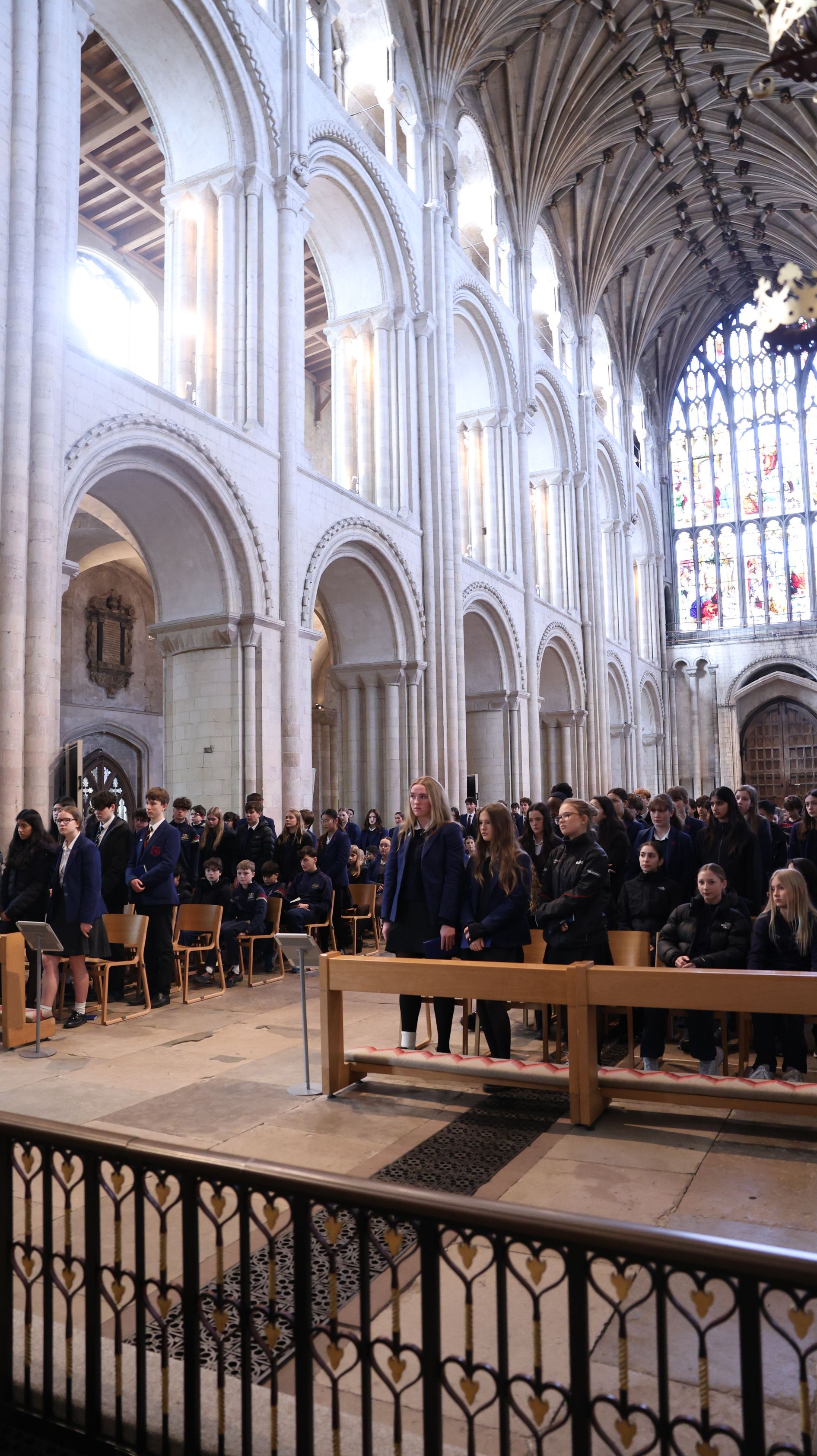
When your year group or form is called, please stand up silently and remain standing until I ask you to sit.
Please will Lower 5, Middle 5, Upper 5 and Lower 6 stand
Look around you. The number of people now standing represents approximately 62% of our school, and that figure represents the proportion of young women aged 18 to 34 who have experienced online abuse or harassment. That is roughly 2 in every 3 women.
[Please sit.]
Online harassment has only become more serious in recent years, as our digital and real lives become ever more intertwined. New forms of exploitation, including deepfake technology, are exposing women and girls to harm on a scale we are only beginning to understand. But this is something we have the power to change. We can be the generation that says no to these behaviours and works to build a safer, more equitable world online.
Please will Lower 4, Middle 5 and Upper 6 stand
The pupils now standing represent around 44% of our school. This figure reflects the proportion of women aged 16 to 34 who have experienced catcalling, unwanted sexual comments, or street harassment.
[Please sit.]
Street harassment predominantly affects young women, and its impact runs far deeper than the moment itself. It shapes how safe women feel walking down the street, affects their confidence and self-esteem, and can limit their independence. We can be the generation that ends this, not by looking the other way, but by speaking up, challenging the behaviour, and holding each other to a higher standard.
These two statistics are just a glimpse into a much wider picture. Women still face significant barriers in education, employment, and daily life, both here in the UK and around the world. Many of these barriers are preventable. And they can be overcome in our lifetime, if we choose to act.
So let's also look at the progress already made.
Please will Upper 4 stand
This represents 10% of our school — the percentage of female MPs in the House of Commons back in 1997.
Please will Lower 5 and Upper 5 also stand
Now we have 40% of the school standing. That reflects the proportion of UK MPs who are women today, 263 women in the House of Commons, the highest number in our history.
[Please sit.]
More women in Parliament means women's voices are heard more clearly in the decisions that shape all of our lives. It gives a real voice to issues impacting women and means legislation is shaped by a deeper understanding of women's experiences. That is real, tangible progress.
Please will Lower 4 stand
This is around 9.5% of the school — the percentage of FTSE 350 company board positions held by women back in 2011.
Please will Upper 5 and Upper 6 also stand
And this is 43% — where we are today. In just fifteen years, representation on company boards has transformed. That is not a small shift. That is a movement.
[Please sit.]
I hope that seeing these numbers standing in front of you, as people, not percentages, has given you pause to think. The women experiencing gender-based harassment and violence are not statistics. They are individuals with their own stories, their own lives, and their own potential. And the women driving change, in Parliament, in boardrooms, in their communities, each have their own story too.
International Women's Day is a time to reflect on how far we have come and how far we still have to go, and it is vital we never lose sight of the individuals behind that journey. If we can leave you with one challenge, it is this: next time you see a statistic, don't let it wash over you. Consider the real person behind it, someone with a life, a story, and people who love them. Because collective progress doesn't happen in parliaments or boardrooms alone. It starts with empathy, and empathy starts with us.