MR BARNY PEARCE ADDRESSES NORWICH SCHOOL PUPILS ON THE IMPORTANCE OF HUMILITY

June 20, 2024

On Friday 21 June, Mr Barny Pearce, Deputy Head of UCAS and Politics teacher, addresses Norwich School pupils on the importance of humility.


"Good morning school. For those of you I have not yet met, my name is Mr Pearce, and I joined Norwich School in September last year to teach Politics. In my first year here, it’s rapidly become apparent that this is a school that is full of successful individuals – and I mean full: I’m not just talking about the success of high honours and awards and ties and certificates we celebrate here in Cathedral; I’m talking about the day-by-day success of every single pupil as you work in class, get that homework submitted, and show up to that lunchtime club.


So my question for you this morning is this: in a school so full of success, what is it that makes for a successful person? What does the doorway to success look like?

Now clearly in this day and age the first resort for answering such a deep and important question is to conduct a 5-minute internet search for an appropriate meme. Such rigorous academic investigation quickly turns up pearls like:

If hard work is the key to success, most people would rather pick the lock.

And: If at first you don’t succeed, order pizza.


To be clear: that’s not the end of the assembly. Obviously, our next instinct is to ask AI – which I did, and it said there were 15 key traits of successful people, and then – I kid you not – gave me a list of just 5… I can only imagine the 6th trait was cheerfulness in the face of incomplete lists.

Let down by the internet again, we reluctantly turn to thinking for ourselves: the doorway success? Well, working hard, certainly. Talent? It can help. Resilience when things go wrong – yes. And I hope the wise among you might list the ability to balance hard work with healthy rest.


But how many of you would call to mind the less celebrated characteristic of humility? The dictionary defines humility as having a modest view of one’s own importance – but we often think of humility as a kind of weakness, grovelling, looking down on ourselves.  Viewed that way, why would anyone want to be humble?

But it’s my suggestion to you this morning that humility is both essential to success, and it can inspire success. Imagine later today that a new homework task appears on Microsoft Teams. A notification will pops up on your computer, and you see the following: “Assignment heading: Build a full-scale copy of Norwich Cathedral. Details: Your replica must be an exact copy, with like-for-like materials, identical size and scale, and – crucially – it must be still as solid in a thousand years’ time. Feel free to work in pairs.”


Now look around you – take in the size of the pillars, the intricacy of the stonework, the height of the roof. Imagine what it takes to find, shape and move a single block of stone for a single pillar. Granted, I’d probably have to set a deadline of a couple of hundred years, but even then, the only sensible response to such a task is to see that you don’t even know where to start. I wouldn’t even know how to start making the pulpit I’m standing in now, and just the thought of that task makes me feel rather small.


Only those with the humility to admit that the task is bigger than they are, that the scale overwhelms, and that there is much that must be learned and countless people to depend on before the task can even begin, are likely to have even the slightest chance of success.


The Christian faith is full of the message that having too high a view of yourself makes the doorway to good things that much harder to find. It’s a faith where those who exalt themselves – that is, who brag about their own greatness – will be humbled, and where those who humble themselves will be exalted. As Daniel read to us, we need to know that our thoughts and our ways, great though they can be, are, ultimately, limited and – in some cosmic sense – rather small.

But Christianity does not simply look down on people, and neither is my suggestion that humility is the key to success about making us all feel insignificant. The Christian answer to the question “Are humans weak or strong, fabulous or flawed?” might surprise you: it’s both… Weak and strong, fabulous and flawed. Christianity is the story of an all-powerful God humbling himself to become a vulnerable human - a human who could have crowned himself with earthly glory, but instead died on a cross to rescue his people. Why? Because humans were not only flawed enough that he had to, but precious enough, and loved enough, that he was glad to.


Whatever your own beliefs, I invite you to consider applying something of this thinking to some or other aspect of your day-to-day life at school. As end of year exam results wash up on the shores of Trinity term, there will be both successes to celebrate and mistakes to own; after that next sports fixture, or musical performance, or D of E trip, or presentation that you give, there will have been both successes and slip-ups. Having the humility to acknowledge where there is learning still to be done – that’s the doorway to success.


And if you need a reminder of this doorway to success, look no further than the actual doorways through which you’ll leave in just a few minutes’ time. Those doors are – I’m sure you’ll agree – impractically large. Have you ever wondered why? How tall were these medieval church-goers? Did they ride here on giraffes? Well, for one thing, in a building this size, dedicated to glorifying God, an ordinary front door would have looked odd. But perhaps those great doors offer two other reminders: on one hand, these impressive doors in this stunning building remind us of all the great skills & talents that people working together in a community possess – I promise not to set you that Teams task, but this stunning place was built by ordinary people just like you and me. You are capable of incredible things.

But those great doors might also serve to give us a humility nudge as we head off to our day. It’s hard not to feel small as you skulk under their great arches. Those doorways to success remind us of all that we are capable of, but they might also keep us humble enough to know that we’ve still got some learning to do."
By Eleanor Lewis • October 1, 2026
On Thursday 1 October, the Library Department celebrated National Poetry Day with its annual Poetry Slam. A number of pupils took to the stage to perform, sharing both original poems and works by established poets and writers. The event provided a platform for pupils to express themselves through the spoken word, with performances covering a wide range of themes and styles. Those in attendance were highly supportive, creating a warm and encouraging atmosphere throughout. It was a wonderful celebration of literature, creativity and pupil voice, and a fitting way to mark National Poetry Day.
By Eleanor Lewis • September 29, 2026
My experience with languages ~ Belek M Reflecting on a memorable week at the Goethe-Institut London
By Sonja Mitchell • September 29, 2026
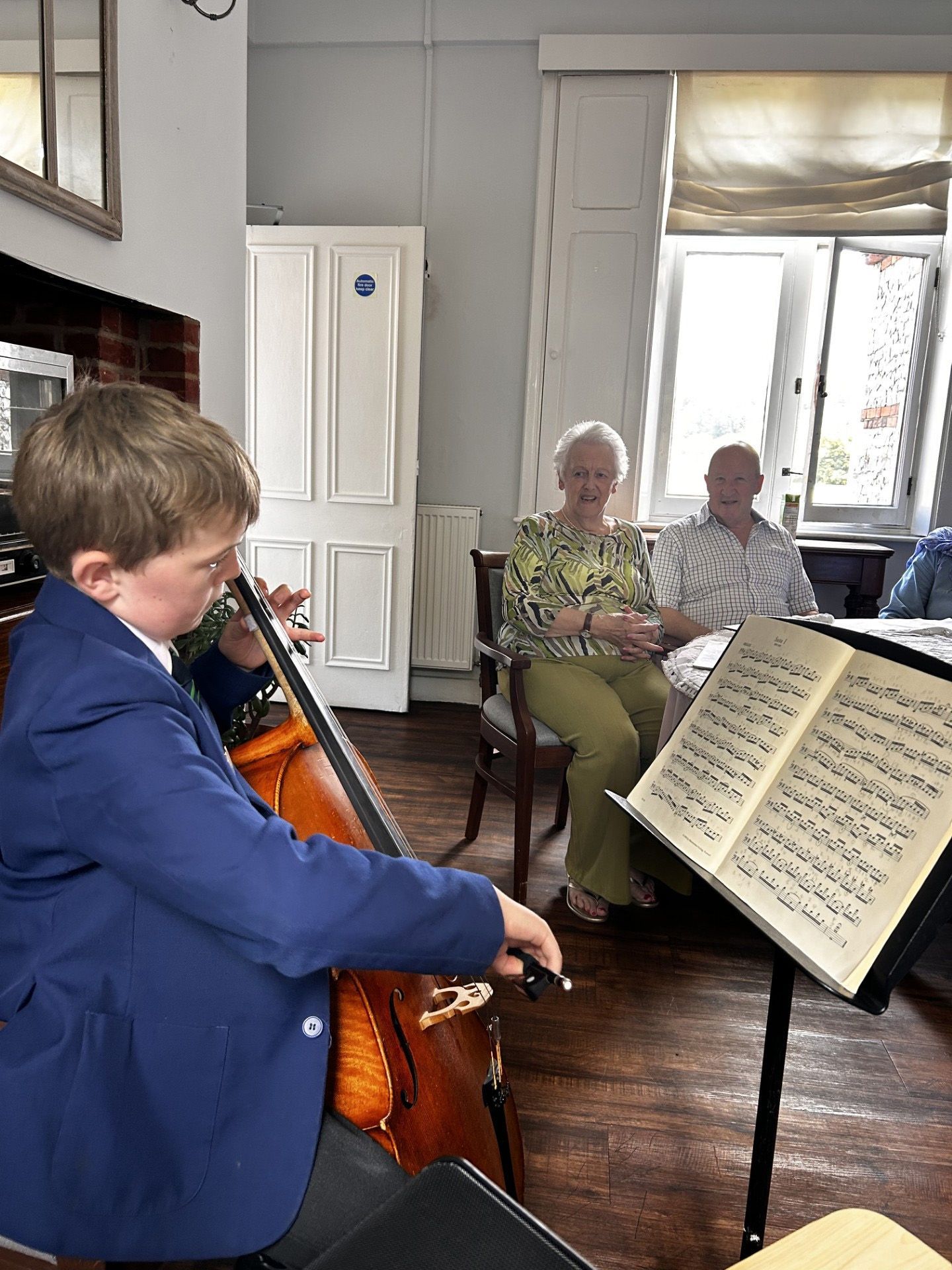
Our Lower 3 pupils took to the concert platform in style with a fantastic Lower 3 Informal Concert , showcasing an impressive range of instruments, musical styles and performances. The programme had something for everyone, from the cheerful piano bounce of Pauline Hall’s Merry Go Round and Beach Calypso , to the elegant Gavotte by Jean Baptiste Lully on cello. We also heard a beautiful Allegro from Violin Concerto by Rieding, alongside Barbara Arens’ playful Hug a Pug . There was plenty of musical character too! The trumpet brought some wonderfully dragon-like drama to Jaap Kastelein’s March of the Drunken Dragon , while the cello took us into the magical world of Zelda’s Lullaby by Koji Kondo. The violin also had its moment with the lively Fiddle Faddle , and the concert took a festive turn with Carol of the Bell s. And, proving that it is never too early for Christmas, we even had a spirited performance of Jingle Bells on the piano! Director of Music for the Lower School Mr Vine said "what a brilliant evening of music making, lots of fun and brimming with confidence. Bravo to our Lower 3 performers" Our next Informal Concert is on the 8 October and will feature pupils from Lower 2 and Upper 2.
By Sonja Mitchell • September 28, 2026
With funding from the Friends of Norwich School, thousands of music sheets can be stored and managed more effectively.
By Sonja Mitchell • September 28, 2026
This November, Tom is taking part in Ride25, raising money for 1moreChild.
By Eleanor Lewis • September 25, 2026
On Friday 25 November, Norwich School celebrated the European Day of Languages throughout the Senior School! This year, a treasure hunt was held in tutorial which sent the the whole school running around to find the answers. At breaktime, pupils enjoyed playing a range of boardgames in the Blake Studio and the refectory served an amazing lunch with three types of German sausages with sauerkraut or a very authentic paella!
By Eleanor Lewis • September 29, 2026
Jonathan Pearson ON and Development Director gives us his take on leadership and service in the Norwich School community. Good morning, everyone. Not a day goes by without me greeting an ‘old friend’ in The Close. From his prominent vantage point, this military veteran keeps a very close eye on his school. Braving all weathers, his is a reassuring presence. If you think I am referring to Ronnie our longstanding Gatekeeper, faithfully manning the playground and monitoring proceedings, that would be a fair guess. At the school’s Remembrance Service, he is occasionally smartly attired in veterans’ uniform and sporting service medals. His understated professionalism from his blue hut keeps us all safe. He is periodically assisted by former bouncer, Pete, a commanding presence. Last year Pete dramatically came to the aid of a chocking pupil by performing the Heimlich Manoeuvre. Modest heroes both, the service of Ronnie and Pete to the school is exemplary. However, as we approach the anniversary of the Battle of Trafalgar, it is in fact Old Norvicensian Horatio Nelson to whom I was referring at the start of this address. His statue has stood on its Upper Close plinth since 1856. At installation, there were intense discussions on which way to orientate it. Should he face south to watch over the beautiful 44 acres of the Cathedral Close and the Duke of Wellington? Should he face west on to Tombland, the original centre of medieval Norwich? Or perhaps face east and as a man of God, take comfort from observing the timeless worship of this Cathedral. But no! The City Fathers orientated him firmly north towards his old school, his steely gaze fixed for eternity on the Chapel, his former classroom (in fact the only classroom in Norwich School in the 1760s). He is without question our most famous alumnus, a Norfolk man, who gloried in being so. It is right and proper that, in this intellectually curious and sceptical age, we should feel compelled to examine Nelson rigorously - the man and his legacy. There will inevitably be a range of opinions when considering him through a uniquely 21st century lens. Indeed, during the Covid lockdown the statue was vandalised. This, coupled with the work of incontinent pigeons, has required his statue to be professionally cleaned twice this decade. However, two things about Nelson never seem to be in doubt: Firstly, he was hero-worshipped in his lifetime. As news of his victory over the Franco-Spanish fleet at the Battle of Trafalgar was rushed to the Admiralty in London, joy was swiftly overshadowed by dismay at the news of his untimely death, aged just 47. Men openly wept in the street as his funeral cortège passed. His Norwich statue is mirrored by a commemorative one in Yarmouth and, most famously, yet another in Trafalgar Square, itself named in his honour. Thanks to this, he is an internationally recognised Briton. Never questioned are also his personal bravery, leadership and service to his country. Many people demonstrate similar qualities, but Nelson wore his bravery on his sleeve – quite literally! He lost an arm and the sight in one eye in service, whilst poor ship’s diet and chronic stress were reflected in his diminutive statue and sallow skin. Notoriously, he also suffered from horrendous seasickness. His courage was immediately apparent to all who met him. We talk a lot about bravery, leadership and service each autumn at Norwich School. I found myself reflecting on Nelson’s battle injuries since an issue with my own eyesight last year. On a Monday morning, I experienced clouding in one eye, and by evening I was all but blind in that eye; on the Tuesday I was diagnosed with a detached retina and operated on later that day. The miracles of modern medicine saved my vision, but Nelson had no such luxury. An eye injury sustained in 1794 in Corsica caused pain and debilitating headaches for the rest of his life, and the sight in his right eye. An explosion as he attacked the ramparts in Tenerife in 1797 caused a catastrophic injury to his right forearm. Remedy was swift and brutal: immediate amputation, with only rum to dull pain that would take five long months to subside. On the corridor that runs to the Head’s Study from the Quad, we have on display an original letter written in copperplate handwriting penned by Nelson’s right hand dating from 1787, and adjacent to it another written by him in a scarcely decipherable left-handed scrawl on HMS Victory in 1804. His right arm and writing hand had been lost in the interim period. Go seek them out! I greatly enjoyed a recent visit to HMS Victory moored in Portsmouth, particularly seeing Nelson’s private cabin. Responsible for a fleet of 31 vessels, formal handwritten orders conveyed between ships or updates to naval masters back in London were an ever-present requirement of his role. Nelson had a relentless work ethic, generating prodigious quantities of paperwork. Reflect on his daily privations: use of his non-writing hand, using his one good eye in the gloom by flickering candlelight in cramped conditions, plagued by seasickness on a rolling boat. A heroic achievement in itself. When Napoleon’s fleet threatened invasion of our country, the Admiralty and the nation put their unwavering faith in Nelson to deliver us from such existential threats. Nelson too knew this was his destiny. His career concludes with heroic acts of leadership shown on 21st October 1805, the day he died. Battles at sea in the early 19th century were violent, bloody affairs. The range and accuracy of cannons were only effective up-close, pummelling the enemy into submission. In the tranquillity of today’s Cathedral, it is scarcely possible for us to imagine the sounds, smells, injuries and terror of such carnage. I have though here a cannon ball from the Battle of Copenhagen, fired by Nelson’s flagship into the wall of that city in 1801. In the late 1980s, it was duly returned to us by a visiting Danish delegation. Imagine this being fired at you from here to say the middle of the nave; it would have readily taken heads off. After this service I will wait by the Cathedral door if anyone wants to feel the weight of it. Visualise Nelson in formal vice-admiral’s uniform proudly patrolling the upper decks of HMS Victory, dictating the hellish pace of battle, as his flagship pierced the French line and began pounding enemy ships. It seems sadly inevitable that a French sharpshooter in the rigging of the French vessel Redoutable alongside HMS Victory should have had an easy line of sight for that fatal shot through Nelson’s chest. News of British victory at Trafalgar, which would secure our Mediterranean shipping routes for over a century, reached Nelson as he expired. So, what can we learn from the much-vaunted leadership and service displayed by Lord Nelson? Well, one lesson might be that acts don’t have to be monumental to be important. Gatekeepers Pete, with his life-saving first aid, and Ronnie, with his daily vigilance, are wholesome examples of serving the community with distinction. As is the leadership shown by our fine new prefects, rousing captains on the sports field, or numerous acts of kindness shown by L6 during Community Service. You will all have your own everyday examples. Perhaps reflect on the words with which Mr Griffiths started this term, the famous quotation from car magnate Henry Ford: “Whether you think you can, or you think you can't, you're right!” I am sure Nelson would have believed that too. Despite all physical challenges, his destiny was a self-fulfilling prophecy. His implicit belief in himself, and the crews he led, shaped the course of Britain’s history, even at great physical cost, and eventually the ultimate sacrifice. Therefore, as you pass Nelson’s statue, I invite you to consider in that noble face a mindfulness that your self-belief, leadership, courage and service to others genuinely influences outcomes. You may or may not be a great hero in later life, but, with courage and kindness, we can all be a hero today in some small way. 
By Eleanor Lewis • September 23, 2026
2026 is National Year of Reading and we are going all in here at Norwich School! We know reading expands worlds, sharpens minds, and fuels creativity, so let's get inspired! Every month we are focusing on a different genre and hearing from a member of staff about what they like to read, why, when and where! For the start of a new school year, we’re talking to Mrs Hewitt about her favourite genre. Let's find out more about why Mrs Hewitt loves the great American novel... . Tell us a little bit about the genre; what common themes or elements do you particularly enjoy? I’m not completely sure this is an accepted genre, but I have always been drawn to American novels from the 20th century. Characters in these novels live harder lives than me. Life is not generally kind to them and they are not always kind to others nor make the ‘right’ choices. You can explore human frailty and resilience in the face of poverty, social disapproval or upbringing without ever leaving your cosy armchair. What was the book that introduced you to American novels? Was there a particular book or author that made you fall in love with this genre? Children’s books were nowhere near as varied and diverse when I was young. I grew up reading Noel Streatfield, Enid Blyton and Louisa May Alcott and other books written when my grandparents were young and if they weren’t written ‘in the olden days’, they were set ‘in the olden days’. Studying A-level English, French and German literature meant that I had many weighty tomes to plough through in my late teens, so discovering The Outsiders by S.E. Hinton and The Catcher in the Rye by J.D. Salinger in the school library opened my eyes to the idea that a book’s hero could be my age with a teen’s outlook. They put me in the shoes of people who were far bolder, more unconventional and exciting than me. Has your taste in this genre changed over time? Yes. I am less inclined to accept misogyny in books now. You could argue that Charles Bukowski intentionally set out to make his nihilistic alter ego Henry Chinaski to be unpleasant and repellent, but if I were to reread, I would rather choose The Best of Everything by Rona Jaffe, which is a great insight into life for young women in the early 50s dealing with such attitudes. Would you recommend this genre to someone who doesn’t usually read it? Why? I’m happy to tell people about books I’ve enjoyed, but rarely recommend any, as enjoyment of a book is so personal. I’ve recommended some of these to my son, but he won’t be told and flat-out refusal is just annoying. So, all I can say is that millions of people have loved them, but you may not. What do you enjoy most about reading, whether an American novel or anything else? I read to experience lives I will never live and to get to know people I will never meet. When and where is your favourite time and place to read? On public transport, as there are no other tasks or distractions to take me away from my book. I can fully disconnect from what is around me. A three-hour train journey? Divine. Yes please. Tell us a little bit about the genre; what common themes or elements do you particularly enjoy? I like the fact that I never know if the ending will be happy. The genre is typically described as ‘gritty’. These books focus on people who are on the edges of society, whether by choice or by circumstance, in a time of powerful, narrow-minded social judgement. I saw New York through the eyes of James Baldwin’s gay, black jazz musician Rufus in Another Country ; I enjoyed pool-hall hustles in Hard Rain Falling by Don Carpenter, a 24-hour dance competition in They Shoot Horse Don’t They? (Horace McCoy) and came face-to-face with the grim reality of war for young soldiers in Norman Mailer’s debut novel The Naked and the Dead. If you could step into the world of any book, which would it be and why? Well, I certainly wouldn’t step into In Cold Blood by Truman Capote and I’m not sure if I would survive On The Road in the way that Kerouac did, although I’d certainly enjoy travelling across America. Perhaps I would do this with Joan Didion instead in The White Album , or with John Steinbeck and his dog in his caravan while he wrote Travels with Charley and I could tell him how much I love East of Eden . Click here to see the monthly reading list!
By Eleanor Lewis • September 23, 2026
Deep in the summer holiday, my dishwasher broke down. It started beeping maniacally, relentlessly and making a deep, unhealthy gurgling sound. We are dependent on technology in so many aspects of our lives, it is frustrating when that dependency is abruptly cut off. An August of suds and rubber gloves was an unwelcome prospect. I have little skill to fix mechanical things. Very little. Faced with this problem, I thought I’d turn to someone - or some thing - in my household that might help: my own intelligence fell short so I thought I’d see if Artificial Intelligence could assist me in my predicament. Could one machine fix the other? I fed the symptoms of my dishwasher’s distress into the Large Language Model, Google Gemini. ‘What should I do?’ I asked it, pathetically. It quickly diagnosed the problem: water was trapped in an inaccessible part of the machine. Now, I do own an assortment of under-used screwdrivers; with a flash of inspiration, I suggested that I could unscrew some prominent screws at the bottom of the dishwasher. ‘No!’. Gemini advised me. Sensibly, it told me to not do that under any circumstances or I would break the thing forever. Screwdriver hanging limply in my hand, my exchange with Gemini continued… You will know Artificial Intelligence is the subject of much debate. Some claim, optimistically, that it will revolutionise human life for the better, solving difficult problems and removing drudgery. On the other hand, some claim unrestrained AI development could lead to the extinction of humanity. That would, at least, solve the dishwashing problem. For those of us in schools, the emergence of generative AI poses a challenge to the purpose of education; it can now do many of the tasks that have, until now, been the preserve of humans. Put simply: AI can – efficiently – find any information, read and summarise a text, write fluent and polished prose, offer instantaneous translation, complete every part of a mathematical or scientific problem, and generate music or art in any genre. Is it, therefore, still important to learn to do these things for ourselves. Before Easter, I asked senior year groups for their views on AI. I am grateful to the 400 in U5 and above who responded with eloquence, supported by their experiences. Whilst many noted positives - that AI can bring efficiencies – it was notable that the majority expressed concern, frustration or even anger about the impact that AI may continue to have. Some cited environmental concerns, or problems of biased, deepfake or hallucinated information. Many noted that AI can compromise academic integrity and enable cheating. A majority expressed concern that dependence on AI may result in people losing the ability to think critically or independently. This view is increasingly supported by hard evidence. A study by MIT in the USA last year indicated that dependence on AI for essay writing resulted in students having a much shallower understanding of the subject, weakening their critical thinking and formation of long-term memory. A recent Chinese study of 27,000 students found the exam performance of those who used AI for their regular work was worse than those who did not. Many of you said you are confused about what is permitted and that the school has not given sufficient guidance. That’s a fair point. The answer is not simple, but I can set out some broad principles. Firstly, in the age of AI, the cultivation of your intelligence and creativity remains an intrinsic good. Intellectual and creative effort has value. Even if AI can do a task, we should be interested in developing our own learning for its own sake; to encounter astonishing new things that change us as human beings. To let you into a secret: when I set a history essay to a class, it isn’t because I actually need 25 copies of that essay. It is because the process of producing the essay develops your learning. Efficiency in production is not the goal of education. Learning requires your brain to work hard and you can’t bypass that difficulty or offload it onto someone or something else. It would be analogous to repeatedly drive a car for 26 miles in the expectation that you will be fit and prepared to run a marathon. Secondly, if AI is used, it should be to support learning, not undermine it. There are AI tools that can be powerful in helping to develop thinking and your teachers may introduce these to you. But their use should not circumvent intellectual effort that is a necessary part of learning. Thirdly, we recognise the growing importance of AI literacy; as the technology becomes embedded into our lives, it is essential that we understand its capabilities and limitations, as well as ethical questions that are raised in a world where AI may become ubiquitous. Mr Fisher has done pioneering work on this with his Fifth Form Elective course and I look forward to working with Lawrence Doe on his red gown project to develop how we do this further. Finally, AI must not diminish our humanity or our relationships in this community. The ‘real’ matters and it was clear in your feedback that many of you are repelled by AI-generated material that is synthetic or impersonal. In particular, you felt strongly that if you put time, effort and love into something, that you want it recognised and considered by a teacher, not assessed by a machine. As with all technology, AI should remain a tool in service to our needs. Dependency on technology for intellectual tasks – tasks much greater or more complex than washing dishes - runs the risk that we become incapable. So, what was the resolution of my dialogue with Google Gemini? It concluded – firmly - that I should step away from the dishwasher, lay down my screwdriver, and call out a mechanic; a real person with the knowledge and skills – the human intelligence - required. When he arrived, he sorted the problem within 15 minutes. I could return – sheepishly - to my dependency on the machine.
By Eleanor Lewis • September 22, 2026
The final of RELEASE 2026 , Guildhall Young Artists’ (GYA) composition competition, was held on Saturday 12 September at Guildhall School’s Milton Court Concert Hall. The event was hosted by Jeffery Wilson, founder and Creative Director of RELEASE, and actor and Guildhall alumna, Sophia Roberts, and featured premiere performances of twelve new compositions. The finalists were chosen by an adjudicating panel consisting of saxophonist and owner of Saxtet Publications, Tom Bruton, Deputy Head of Electronic and Produced Music and Lead Professor of Film Music at Guildhall School Barbara De Biasi, composer, orchestrator, and arranger Matthew Sheeran, and Sub-director of Studies and Teaching Associate at St John's College, Tim Watts. Upper 5 pupil, Isaac S, won the ‘Release the Song’ category with his setting of two Shakespeare songs. Hear them here on YouTube. He will receive mentoring from ‘Audio Network’ professionals and attend an orchestral session at Abbey Road as well as a live masterclass with Paul Ressel and a cash prize. Isaac was also awarded second place with his string quartet Burnt Norton. Isaac commented: "The joy of the whole thing is that it's such an eclectic competition, there's been a really wonderful breadth of entries and it offers opportunities to young composers in all genres, forms and all media. There are so many opportunities across a whole breadth of disciplines out there and it represents many of them. It's wonderful to have more recognition wanting to go into composition professionally later in life."
More Posts