“If we’re kind and polite, the world will be right.” - Katie Grote Addresses Pupils

February 7, 2025

Let love be genuine; hate what is evil, hold fast to what is good;

love one another with mutual affection;

be ardent in spirit; be patient in suffering.

Extend hospitality to strangers.


Bless those who persecute you;

Rejoice with those who rejoice; weep with those who weep.

Do not be haughty.


If it is possible, so far as it depends on you, live peaceably with all."


Today’s reading comes from St Paul’s Letter to the Romans. Yes, that’s right - the Romans. I am Mrs Grote, I am part of the Classics Department where we teach Classical Civilisation, Greek and Latin to many of you: 

But that’s not why I was recently drawn to this letter to the Romans. 


No. Today’s reading, written 2000 years ago, came to mind this Christmas when I was sat in the cinema. 

I am not a frequent cinema goer, but recently I found myself there twice, and on consecutive days. 

One trip had comfy velvet sofas, waiter service and a glass of wine; the film was Conclave: set in the Vatican, the heart of the Catholic Church, about the election of a pope. Surely it was this film, set in Rome itself, with spoken and sung Latin, that led me to think of Paul’s Letter to the Romans; no, today’s reading came to me on my other cinema trip: no wine this time, no comfy sofa, just the standard seating of the Odeon, and a fidgety six year old for company. The film? Paddington in Peru. 


For those less familiar with this recent heartwarming movie, Paddington and the Browns make a journey through the Amazon to find Paddington’s beloved Aunt Lucy who has gone missing from her home for retired bears: on their dangerous quest, they face everything from white water, to poisonous spiders: yet the cause of their survival, as well as the original reason for the journey, is the family’s love for each other.


Today’s reading urged us to “love one another with mutual affection” to “rejoice with those who rejoice, to weep with those who weep.” In other words, like Paddington and the Browns, to love and support each other, in good times and bad.

In Paddington 2, things go wrong for Paddington. He is wrongly imprisoned; but during his jail sentence the prison changes from a place of darkness and hostility to a place of kindness and hope, because of his actions: he teaches his inmates to make marmalade, he brightens their surroundings with flowers, and tea parties, and, in doing so, a sense of community is renewed.


Earlier in his letter, St Paul talks of a love that is genuine. Paddington’s small kind acts in the prison are small acts of love, of genuine love. Nothing grand. Nothing rehearsed. Just simple, sincere actions, that create community and a warmth that is found again and again in the Paddington films and books. We can likewise create such warmth in our communities:


By holding a door open; by giving up a seat up on a bus; by acknowledging and smiling at someone you walk past, even a teacher. With any one of these, you will improve someone’s day.

However, not every instruction from St Paul’s letter to the Romans is so easy to follow:

Bless those who persecute you; live peaceably with all. 

This is much harder to achieve, but Paddington makes a jolly good attempt. Mr Curry, his nosy and miserly neighbour, is almost always unpleasant and rude to and about Paddington. But Paddington doesn’t hold a grudge; he always responds with goodwill and good cheer. Living peaceably with all doesn’t mean pretending everything is fine or avoiding conflict. It concerns responding appropriately to it. The next time something doesn’t go your way, pause and think: can I respond with understanding instead of anger? Can I, like Paddington, reject conflict and spread peace?


This has already been a lovely, wholesome message for a Friday morning: Paddington and St Paul are all about love and peace; so, off you go; follow their example; spread love and peace. But it wasn’t that message that led me to St Paul’s Letter to the Romans while sat in the Odeon that afternoon. At least not at first.


We sit here in a building steeped in tradition, in particular the Benedictine tradition. Excerpts of the rule of St B are read here at services every day: “All guests who present themselves are to be welcomed; all humility should be shown to a guest. When a guest is announced, he should be met with every service.”


The key teaching of the Benedictine tradition shown here is that of hospitality, offered to all, by all. And here, in the middle of today’s reading, St Paul asks for the same:

Extend hospitality to strangers.

Michael Bond, the 1950s creator of Paddington, knew about this: he knew of families in WWII who gave homes to evacuee children in the Blitz, and to Jewish children fleeing via the KinderTransport. The background of welcoming strangers was very recent history for Michael Bond, as he started Paddington’s story.


When Paddington first arrives in London, he doesn’t know the culture, the language, or how to navigate the city and finds himself alone at a train station. In that moment, the Browns embody the Biblical call and the Benedictine ideal to “extend hospitality to strangers.” He is a refugee, but they do not see him as a problem; they see him as someone in need. They take him in, into their home, their family, and their lives.


But hospitality doesn’t just have to mean house guests or concern immigration policies. Who might need our hospitality today? Is there someone new, someone alone or someone struggling to fit in? Hospitality isn’t only about opening up a home or our borders; it’s about opening our hearts and minds and making space for others in our established habits and busy routines and even into circles of friends; that’s what’s The Browns did for Paddington, and it’s what St Paul – and the Benedictine tradition – ask of us too.


I could go on: St Paul advises the Romans to be ardent in spirit, to rejoice in hope and be patient in suffering. Paddington so often shows relentless optimism, amidst his many many disasters; likewise, he very naturally connects with people from all walks of life – antique dealers, tough, intimidating criminals, bus drivers, shopkeers, bin men – perfectly following the teachings of St Paul and St Benedict about humility, rather than haughtiness.


In the end, the lesson is clear, and it is the same lesson, whether we’re talking about the faith of St Paul in his letter to the Romans, or the Benedictine traditions that shape the life of this cathedral, or the world of The Brown Family and Paddington: who, today, quite rightly, I leave to have the final word:


“If we’re kind and polite, the world will be right.”

By Sonja Mitchell May 8, 2026
The Fourth Form Garden Continues to be a Wonderful Space for Pupils
By Eleanor Lewis May 7, 2026
With the Upper 6 soon to start their study leave, we are going to announce a final selection of university offers and offers for apprenticeships that they have received.  We wish the Upper 6 pupils all the best as they sit their A level examinations and hope that the 20 pupils still awaiting outcomes of one or more of their applications receive good news on these soon. The school’s Apply Plus Programme is run by Mr Pearce. It supports pupils applying to academic courses that require admissions tests and/or interviews. Pupils with Apply Plus offers not previously announced: Lily Mei ML - Foundation Year in Arts, Humanities and Social Sciences at the University of Cambridge This makes the total number of Norwich School offers from Oxford and Cambridge this cycle 11. Daniel AM – Economics at UCL Thomas H – Computing at Imperial College Anish K– Economics at the University of Warwick Humanities/Social Sciences/Languages: Isabel B – Spanish at the University of St. Andrews Edward Bl – History with a Year Abroad at UCL Joel F (ON) – Politics, Philosophy and Economics (PPE) at LSE (London School of Economics) Hannah H - Culture, Media & Creative Industries at King’s College London Darcy W – International Management (including Year Abroad) at the University of Warwick Sciences: Bea F – Environment and Sustainability at the University of Surrey Cynthia L – Neuroscience at UCL Victor P – Engineering Business Management at the University of Warwick Halvard Y - Data Science at LSE Creatives: Will C – Acting (BA) at East 15 Ernie H– Music Production at Northbrook College Lana K – Music Performance – Drums at the Academy of Contemporary Music Isla V– Contemporary Dance (BA) at Trinity Laban Toby W – Architecture with professional placement at the University of Bath Overseas: Gabriel C – offers from both Hong Kong University (HKU) and Hong Kong University of Science and Technology (HKUST) Gilia C and Mari L – offers from Hong Kong University of Science and Technology (HKUST) Apprenticeships: Louise H – Accountancy apprenticeship with Berry & Warren (Norwich) George S– Engineering apprenticeship with the National Grid (Eakring, Nottinghamshire)
By Eleanor Lewis May 11, 2026
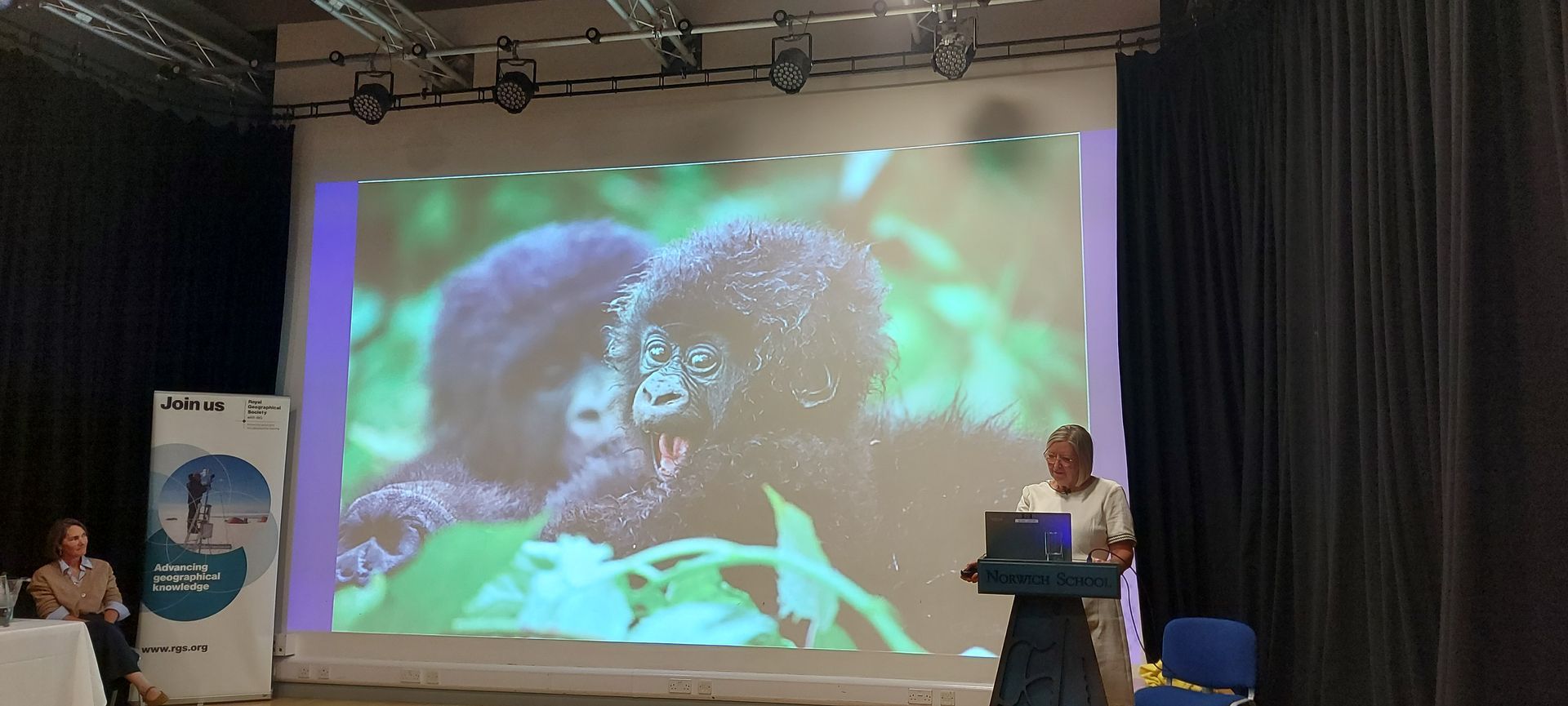
On 07 May 2026, it was with great pleasure that the school welcomed back on site the illustrious Royal Geographical Society (RGS) for the latest in their series of public lectures on site. A capacity audience in the Blake Studio of pupils, staff, parents, alumni, Fellows of the RGS and those with an interest in the natural world heard from charismatic adventurer and Old Norvicensian Toby Hough. His talk was a real treat, and it was a pleasure welcoming him back to his alma mater. Toby is an accomplished and award-winning wildlife filmmaker. His credits include work seen on Countryfile, The One Show, Springwatch programmes, filming for the RSPB, and numerous BBC wildlife documentaries and travel programmes. His career has included working with TV legends including Ray Mears, Julia Bradbury and Chris Packham, and, although Norfolk based these days, he has travelled extensively thought his long career. Many witty and humorous anecdotes ensued, highlighting a fascinating and unpredictable career, often one of great personal discomfort and sacrifice in pursuit of those thrilling ‘killer images’ we see on wildlife programmes. Toby was generous in explaining the complexities of his craft and backed this up with some appealing slides plus a table of wildlife treasures picked up from his global travels. These included a fossilised megalodon tooth, vulture feathers, a walrus tusk, inter alia. An interesting Q&A followed, including some pertinent questions from our younger audience members, carried on over refreshments afterwards. These RGS talks offer intellectual rigour and great entertainment for both the academic and the lay-person alike and are always well worth attending. The RGS autumn programme is being worked out, and we look forward to hosting them here later this year.
By Eleanor Lewis May 6, 2026
On Saturday 9 May, Norwich School choir members will be performing at St Nicholas Chapel with Music in the Burnhams. This concert is a celebration of Sir Karl Jenkins - one of the most performed choral composers in the world. He has composed music for The King, Bryn Terfel, Dame Evelyn Glennie and London Symphony Orchestra. His Mass 'The Armed Man' has topped Classic FM's Hall of Fame again this year and his albums have sold in the millions. He is signed to Decca Records and in 2024 Decca bestowed upon him the unprecedented distinction of a Lifetime deal, the first time the label has made such a commitment to any artist. He was awarded a Knighthood for services to music in the Queen's birthday honours. The concert will feature lots of his most famous works including the Cantata Memoria which Norwich Lower School Chamber Choir and Norwich School Junior Choir are involved with. We are the only school that have been asked to do this which is a huge honour. Sir Karl Jenkins himself will be in the audience for this very special concert featuring members of the Kings Lynn Festival Chorus and the British Philharmonic Symphony Orchestra. The opportunity to perform his work is a great privilege given his standing within the classical genre and to have him at the concert in person is a huge deal. Click here to book now!
By Eleanor Lewis May 1, 2026
The annual History Dinner took place on Friday 1 May, with this year’s theme being ‘revolutions’ from the past. The evening transported over 50 A Level Historians on a journey through time, consuming revolutionary food, listening to revolutionary music, all whilst wearing revolutionary costumes. The catering team did a fantastic job in recreating dishes from times when human beings were foragers, with our very own chefs foraging for the wild garlic and mushroom used in the canapés. The starter and main took guests on an Early Modern adventure, first westwards to try the ceviche of South America, before a superb Hariyali curry from India. We finished off with a modern classic, an upside-down pineapple sponge, in direct reference to the theme of the evening. La Marseillaise & the Hamilton soundtrack featured heavily throughout the event. The pupils’ costumes were an eclectic mix. Chimney sweepers and industrialists ate side-by-side with Soviet revolutionaries and Castro. The wide time span was complete when local heroine Boudicca appeared, as well as tech-revolutionary Bill Gates. The History Dinner continues to grow and is a great way to bring the past to life, as well as giving us a chance to say goodbye to our departing Upper 6 as they go on Study Leave. This was also Dr Farr’s final History Dinner before retirement. A revolutionary in his own right, Dr Farr has taught over 1,000 pupils A-Level History during his long and industrious career. He will be sorely missed and we can’t thank him enough for all he has done at Norwich School, and the History Department in particular.
By Eleanor Lewis April 30, 2026
2026 is National Year of Reading and we are going all in here at Norwich School! We know reading expands worlds, sharpens minds, and fuels creativity, so let's get inspired! Every month we are focusing on a different genre and hearing from a member of staff about what they like to read, why, when and where! Next up we have Crime Fiction for April and a huge fan of this genre, Gillian Wright, Lower School Teacher, is going to tell us a bit about why she loves Crime Fiction so much! Tell us a little bit about the genre; what common themes or elements do you particularly enjoy? I enjoy delving into stories that revolve around secret missions, missing persons, or even a mysterious killer. The suspense, unexpected twists, and deductive reasoning keep me eagerly turning pages until the inevitable surprise ending. These books are often packed with action and clever plotlines that keep readers guessing right up to the final chapter. The most thought-provoking stories are those rooted in real-life situations that readers can relate to, such as The London Eye Mystery by Siobhan Dowd. I also enjoy books that take me out of my comfort zone and offer different perspectives on the world, for example T he Hunger Games by Suzanne Collins. What was the book that introduced you to crime fiction? Was there a particular book or author that made you fall in love with this genre? The book that first sparked my interest in reading was James and the Giant Peach by Roald Dahl. Although it is not a classic crime novel, it is certainly an exciting and mysterious adventure. Aunt Sponge and Aunt Spiker clearly display some questionable—if not criminal—behaviour. I suppose my first real exposure to crime fiction came through The Famous Five adventures by Enid Blyton. I loved seeing how a group of children worked together to solve mysteries without any adult help. From that point on, I have always been drawn to stories filled with adventure, mystery, and unexpected twists. I also enjoy a touch of dark humour, which is why I thoroughly enjoyed A Series of Unfortunate Events by Lemony Snicket. The books are grim, funny, and strangely addictive. Has your taste in this genre changed over time? No, my taste for crime novels has not changed. Although I do enjoy a good historical novel, I will always return to mysteries and crime as they provide intrigue, twists and those quiet ‘aha’ moments. Most recently, I have enjoyed The Thursday Murder Club mysteries by Richard Osman. Would you recommend this genre to someone who doesn’t usually read it? Why? There is something timeless about a good mystery. It isn’t just about solving crimes or catching the villain; it’s about asking questions, noticing subtle details, and thinking more deeply. In a world dominated by quick scrolling and short attention spans, mystery novels remind us that it’s okay to slow down, immerse ourselves in a story, and truly pay attention. What do you enjoy most about reading, whether crime fiction or anything else? Reading is essential to me; it allows me to step away from the busyness of everyday life and escape into magical and mysterious worlds, while also enabling me to explore new perspectives. Books have the power to evoke a wide range of emotions, from joy and excitement to sadness and tension. I love immersing myself in a new story—being drawn along with the characters, seeing the world through their eyes, and allowing the words to take me on a journey. When and where is your favourite time and place to read?/ Do you have a favourite reading spot or routine for diving into books? I read every night before I go to sleep, as it helps me wind down after a busy day and fully relax. On sunny days, I especially enjoy reading outdoors, whether that’s in the garden or by the pool while on holiday. Which fictional character would you most like to have a cup of tea with? I would love to share a cup of tea with Willy Wonka, as he would likely provide an unusual combination of flavours—perhaps even with a side order of chocolate. Do you tend to reread favourites from this genre or always look for something new? I don’t usually re-read books, although I have returned to Roald Dahl’s stories time and again—mainly to allow my children to experience the joy of his imaginative and magical tales. When was the last time a book from this genre really surprised you? The essence of a good crime or mystery novel is its ability to surprise the reader, and they never fail to leave me guessing. I have never yet managed to work out the final twist of a truly good crime novel. Do you prefer classic or modern books within this genre, and why? I enjoy both. A classic tale by Agatha Christie or a mystery involving Sherlock Holmes is always enjoyable. However, more recent authors, particularly for children, have created some new classics, such as the Alex Rider series by Anthony Horowitz or Murder Most Unladylike by Robin Stevens. Has your taste in books changed over the years? I used to enjoy reading the classics including books by Thomas Hardy and EM Forster. Nowadays, I prefer a lighter read intermingled with more challenging stories. I am always up for a good book recommendation. Why do you think reading is important? Reading for enjoyment can spark the imagination, provide an escape, and inspire creativity. It offers a way to discover new worlds, meet new characters, and learn about the past. Above all, it is an easy, enjoyable, and relaxing way to spend time. If you could step into the world of any book, which would it be and why? If I could step into the world of any book, it would probably be Harry Potter . The incredible creatures, magical adventures, friendships and rivalries, along with the mysteries waiting to be solved, all combine to make these stories so captivating. I would love to try my hand at a few magic spells myself. Having visited the Warner Bros. Studio where Harry Potter was filmed, it was amazing to see the sets and costumes used by the characters. It truly brought the stories to life and felt like a real privilege Click here to see the monthly Reading List!
By Eleanor Lewis April 30, 2026
On Thursday 30 April, the Upper 3 Informal Concert in the Lower School Hall felt really special, as we celebrated the pupils’ final Informal Concert together. There was a lovely sense of reflection, confidence and quiet pride throughout the evening. The programme included a great mix of styles and instruments, giving each performer a chance to shine in their own way. The concert opened with a poised and elegant performance of Bourrée on the cello by GF Handel, setting the tone beautifully. Things then picked up with a lively and energetic drum performance of Uptown Funk , which brought great rhythm and a real sense of fun. The mood softened again with a thoughtful and expressive violin performance of Hallelujah , played with sensitivity and a clear sense of line. On guitar, Arctic Monkeys Do I Wanna Know? was performed with a cool confident style, really capturing the feel of the original. The violin returned with Serenade by Schubert, played with warmth and a lovely tone. The piano piece Spanish Guitar added a playful, rhythmic contrast, showing both agility and character, before a bold trumpet performance of He’s a Pirate brought a burst of cinematic excitement. The concert ended with two memorable performances: a moving vocal rendition of I Dreamed a Dream , full of expression and control, followed by Für Elise on piano, where the contrasts and dynamics were handled with care and confidence. Overall, the evening was not just about performance, but about how far these pupils have come in their musical development. Each contribution felt personal and meaningful, coming together to create a memorable final concert. It marked the end of an important chapter but also showed that they are more than ready for what comes next. Head of Music Mr Vine summed it up perfectly: “I am very proud of the commitment and professionalism of our young performers. It has been a pleasure to watch you grow as musicians and you have done so much to enrich the Lower School with your playing. Thank you all!”
By Eleanor Lewis April 30, 2026
The 2026 Norfolk Primary Maths Challenges, hosted by Norwich School, were brilliant days all round, bringing together some of the strongest young mathematicians from across the county for a fun and friendly competition. There were three rounds to tackle—Tangrams, Arithmetic, and lateral thinking—so plenty of variety to keep everyone on their toes. From quick calculations to tricky puzzles and creative challenges, pupils really got stuck in. It was especially impressive seeing such talented mathematicians working so well in their pairs, sharing ideas and supporting each other throughout. The atmosphere throughout both competitions was fantastic. There was loads of creative thinking on show, and just as importantly, plenty of smiles. Alongside the competition, many pupils had the chance to meet others from different schools, make new friends, and enjoy putting their maths skills to the test in a relaxed and encouraging environment. A huge congratulations to everyone who took part—you should be really proud of yourselves. And of course, well done to our winners: Year 5 Primary Maths Challenge Winners: 1st: White Woman Lane Junior School 2nd: Norwich Lower School 3rd: St Nicholas Priory Primary School Year 6 Primary Maths Challenge Winners: 1st: Norwich Lower School 2nd: Cringleford CE VA Primary School 3rd: White Woman Lane Junior School Well done again to everyone involved—it was a great day and we’re already looking forward to next year!
By Eleanor Lewis April 29, 2026
Now here’s a question. What do the following have in common: Heads of Houses Mr Cann and Mr Gent, Miss Adams in Drama, Mr Seaman in Art & Design, Mr Palmer (Print Room), recent graduates Miss Bartram and Mr Thornton in Carter, Miss Clark in Music and Miss Davies in Marketing, Mr Catchpole and Mr Cooper in Daynes, Mr Love, Mrs Anna Curtis, Miss Temple and Mr Newman in the Lower School? If you’ve not worked it out yet, the answer is they are all former pupils of the school, Old Norvicensians, or ONs for short. All work here at Norwich School. My name is Jonathan Pearson, I am an ON and I too work here as the school’s Development Director. One of my key roles is working with ONs, so, understandably, I am delighted many are employed here. The career paths of ONs is the theme of today’s assembly. This list got me reflecting on what occupations my fellow 1987 leavers have pursued nearly 40 years on. It is of little surprise that high-flyers continue to have very public success: Surgeon Paul Manning is now head of the UK’s largest private healthcare company; Charles Forsdick is Professor of French at Cambridge University; career diplomat John Virgoe is the UK’s Envoy to the Commonwealth. Stellar careers all. But what about the 1980s school rebels? Well, Andy Roberts and Tom Wood were regulars in the Deputy Head’s office for various misdemeanours: uniform infringements, non-regulation hair length or colour, partying-related hijinks etc. Yet that same defiant streak now displays itself in savvy, entrepreneurial drive which has seen both set up, lead and sell self-made companies. Many of us were hardworking and unassuming, following all the rules and successfully progressing up the career ladder, modestly and without fuss. This is typified by friends Paul Grainger and Scott Pinching. Both stayed locally and enjoyed fruitful jobs in Financial Services. I greatly admire those who had the courage to follow their dreams: Phil Halls founded and runs award-winning Grain Breweries and Marcus Nash runs a respected birdwatching tour company. I am constantly in awe of what ONs achieve and the positive contribution they make to society beyond Cathedral Close. The point is you will do so too one day. What will your career look like after school, do you think? I strongly suspect if you tried to guess, you would be hopelessly wrong. Perhaps in 40 years’ time you will remember sitting in Cathedral with your whole life ahead of you wondering what the future holds. It is hugely empowering, but a bit scary at the same time. Now, I’m no fortune teller, but I can be pretty confident about five reflections I wanted to share with you today: Firstly, have confidence. Norwich School equips you well for the outside world. You will have academic rigour, but also many desirable, softer skills: intellectual curiosity; confidence; resilience; humanity; dependability; an ambition to lead and to serve. These traits will stand you in good stead. Every one of you will be a great asset to future employers. Secondly, embrace help. Navigating the world of work is tricky. Recent research from the Office for National Statistics shows there are 957,000 16–24 year olds not in work, education or training and that figure has risen sharply post-covid. Finding a job today requires perseverance, skill, some luck and a great deal of effort. However, welcome help is at hand. On leaving school you all automatically become lifelong ONs. We have over 400 ON Ambassadors, who have pledged to give free advice about next steps. Virtually all career paths are covered. Check out the latest ON magazine for details. This is a seriously valuable resource, so do use it. These are ONs who remember only too well the challenges of getting started. They genuinely want to help. Thirdly, embrace change. I wholeheartedly agree with Mrs Warren’s assembly in March 2025 on squiggly careers. You are likely to have multiple career paths. I have had three career pivots myself in my 37 years in the workplace. Change is positive. It keeps life exciting, so harness it. Fourthly, look to the future. I remember my Sixth Form tutor telling me I’d end up doing a job not yet invented. What a load of rubbish, I remember thinking. At that time, I was contemplating a career as a librarian. I thought, to find something out, you looked it up in a physical book. That’s what everyone did. In 1985 I could little have imagined that within four years the internet would be invented, followed by Wikipedia, Kindles and the like. My childish over-confidence was hopelessly misplaced. It’s exciting that you will be doing jobs straight out of tomorrow’s world. A.I. will have the same transformational impact on your lives as the internet has had on mine. And lastly, bank on a long working life. I wager you will be working into your seventies before retiring. Now there’s a thought! My official state pension age is 67, but advances in medicine, nutrition and living standards mean we’re all living and working longer. I suspect you have 50 years of working life ahead. That’s too long to be spent doing a job you don’t enjoy or careers just to meet your parents’ aspirations. A quote often attributed to the Chinese sage Confucius runs: “Choose a job you love, and you will never have to work a day in your life.” So, consider following the example of the ON brewer or the ON birdwatcher and do something that really excites your passion. Well, what about me? If I look deep into my heart the day I left school, I confess I did not want to leave The Close at all. I had very much enjoyed my nine years here and the friendships I’d made, so would happily have stayed. But of course, I didn’t. After University, I moved into property and law, then into pharmaceuticals, but something inescapable pulled me back, and in February 2018 I started working here. Norwich School must be doing something right if all 15 ONs at the start of today’s assembly wanted to come back here too. So, perhaps I have followed my dreams after all, and maybe you should too. To all those leaving this July, I convey best wishes for your future from ONs all round the world.  Enjoy the rest of your day, and thanks for listening.
By Eleanor Lewis April 24, 2026
My talk this morning is inspired by some words that were used in assembly on Wednesday, particularly with the public exam year groups in mind: ‘You will always be part of our school’s story’. It’s absolutely true that school isn’t just a place, or an organisation, or a list of names. School is a story – a story we’re continually creating. Our story-making at this time of year includes things like taking a whole-school photograph, a snapshot of all the people that make up our community at this particular moment. For the Upper 6, it includes contributing to the Leavers’ Yearbook, where you share your memories and anecdotes. It includes holding dinners and special services where we remember our achievements, the unexpected twists we had to navigate, and how the story of the year has unfolded. We do all this because our stories are an important part of our community. Another thing that communities often do with stories is to take an inspiring narrative and make it our own. In Cathedral Close we do that with Nelson, with Edith Cavell, with Julian of Norwich and St Benedict, all of whom have monuments to remind us of their stories. And I want to mention three other stories that, whether we realise it or not, have become part of our culture and therefore part of us. Yesterday was St George’s Day. You may be only vaguely aware of the story of England’s patron saint – that’s true for many people. But you probably remember enough to know that St George was brave; that he faced the fight against the dragon while everyone else feared and fled. Just to be aware of the tale is to have before you an ideal of courage and standing up to adversity. That’s why St George has become one of our foundational stories. The second story is, in a way, a Biblical version of St George: the story of David and Goliath. Goliath is the towering brute who has no care for anything or anyone. David is barely out of shorts – but he is plucky and he is faithful and his slingshot skills (from his time as a shepherd boy) allow him to fell the giant. If you know that much, then you’ll carry the message of the story with you. You may be young, you may be unknown, you may be inexperienced, but if you’re bold and you’re faithful, who knows what you might achieve. And if we know about David the giant-killer, we will notice when someone like Greta Thunberg publishes a book called No One Is Too Small to Make a Difference; and our ears will prick up when someone like Malala Yousafzai finishes a speech with the words, “One child, one teacher, one book and one pen can change the world.” The third story is the one that causes cathedrals like this to be built. It is the Easter story that is always told at this time of year. It is the story of someone who took on a spiritual battle, because this person’s resistance (unlike in the first two stories) was consciously non-violent. It is the story of someone who faced the powers of death and darkness alone while everyone else feared and fled. It is the story of someone who, out of love, went to the cross. It is the story of someone who death could not defeat, as his disciples began to realise on the very first Easter morning. If you know the story of Jesus, along with the story of St George and David, then you will have ideas about courage, and faithfulness, and things worth fighting for, that one way or another you will want to incorporate into your story, as the story of your life continues.
More Posts