Head's Address at the Beginning of the 2024/25 Academic Year

September 4, 2024

It is terrific to see the whole school back in the Cathedral after a summer apart. I trust you are looking forward to the year, both individually and as part of the wider school community. 


Regarding this balance of hope for us as individuals and together, I think many of you have already walked past two prominent figures in Cathedral Close, each of whom has something helpful to say. And if you have not yet done so, I think most of you will do so before the end of the day and all of you before the end of the week. Any guesses? I am talking, of course, about the statues which stand either side of the mighty doors of the West End, located behind you as you sit in the Nave: as you look at the Cathedral from the West Front, Julian of Norwich is on the left holding a book and St Benedict is on the right with his finger to his lips. For those who are new to Norwich School (and the less observant of you from past years), cast your eyes up when you next walk past. 


Mother Julian was an anchoress who chose to live in the walled-up cell of a church not far from here in Norwich during the late 1300s and early 1400s. She is credited with writing the first book in English by a female, Revelations of Divine Love, which describes visions of Christ that she experienced; it is the book she is sculpted with on the statue outside. Among her most famous statements is: “All shall be well, and all shall be well, and all manner of thing shall be well”. Whether you are a person or faith or not, one cannot help but be struck by the confidence and optimism of this statement. It is almost certainly the earliest example of manifesting in the English language. I think it is a timely phrase as we set about this new school year: there is much uncertainty in the world and much even in our own lives that we cannot control, but we can trust the process of the educational year which starts up again today after the summer and afford to be optimistic that our own ambitions can be achieved. 


Indeed, this quality of hope and optimism is one of the reasons I love working in education. Young people, yes you, this amazing group in front, around and behind me, set about life with a collective cheerfulness and joy; it has been wonderful already to hear the babble of chatter as you make new friends or catch up after a summer apart. Sometimes you are not realistic or hopeful, but often you get what you want because you are confident that you can achieve your goal and simply take the steps to make it happen (I mentioned this flippantly before, but it is true that manifesting and visualising are modern terms associated with this process). Regardless of details of your individual ambition, whether in academic work, sport, music, drama, dance, debating, Warhammer or anything in between, I want each of you to be positive and joyful as you start this new year; I hope Julian’s statue will encourage you to keep going for your targets as you walk past it during the year. 


The right-hand statue as you look at the West doors of the Cathedral is St Benedict, holding a finger to his lips for quiet prayer. From its foundation in 1096 until the Reformation of the 16th century, this Cathedral Church was a community of monks which was part of the Benedictine Order. If you were to attend Evensong this evening, you would hear a passage being read out from his guiding words, called the Rule of St Benedict. 


At a service in the summer, Canon Aiden, one of the Canons of the Cathedral and a governor of the school, spoke of Benedict’s interest in mutual obedience, the need for the monastic community to pull together to be effective. In a modern world where rights are sometimes trumpeted more than responsibilities, Canon Aiden noted that this concept of mutual obedience is not fashionable. However, its importance resonated for me in subsequent weeks because of the civil unrest that was witnessed in many parts of the country. Sparked by the spreading of misinformation in the wake of the horrific murders in Southport, episodes of civil disobedience involving both violent conduct and expressions of ideological extremism sprung up in different parts of the country during the first part of August. 


The hostile intensity of these events shocked the country because they demonstrated how quickly respect for the rule of law can be lost in certain circumstances. Mercifully, there was no major incidence of disorder in Norfolk during this period, though nobody should be under any illusions that the significant differences of opinion which underpinned the unrest exist in this part of the country, too. 


The quality of our Norwich School community is one of our signature strengths, perhaps even the most important. However, this only remains true because we actively work at it, because we behave in a way each and every day that makes it the loving, compassionate, inclusive community that we cherish so much. That does not mean that we all have to agree with each other all the time; indeed, we are so much more vibrant and thoughtful because from time to time we disagree with and challenge each other. However, when that happens there must be a tone of mutual respect and we must be careful not to over-personalise any disputes that arise. 


Unconditional positive regard for each other is a key phrase we use here; it comes centuries after Benedict’s discussion of mutual obedience, but I believe there is a strong overlap in thought. There is for me a sense in each idea that we may not get exactly what we want from an exchange, we may need to agree to disagree respectfully with another member of our community and we may need to compromise to achieve mutually agreeable practical outcomes. Yet, this compromise at an individual level is worth it for the community benefit. Schools are crucibles which can hold a range of opinions in a framework of mutual respect for each individual. 


On too many occasions in the modern world, complex issues are broken down into overly simplistic, even binary, choices by people holding extreme views on each side of a particular debate, often by talking in echo chambers only to those of a similar opinion. I should like us to resist such a trend here at Norwich School, to look after each other both as we work together in this amazing environment and as we communicate online when we are not in Cathedral Close. This is very much the collaborative spirit embodied in today’s bible reading: “clothe yourselves with compassion, kindness, humility, gentleness and patience. Bear with each other and forgive one another if any of you has a grievance against someone. Forgive as the Lord forgave you”. We do not always need to agree, but we should continue to respect each other if and when we disagree. 


The statues of Julian and St Benedict, which oversee us as we move about The Close during the year, will be good touchstones to encourage our individual ambitions and to harness them positively in the life of the wider community. Both as optimistic individuals and a cohesive, kind community, I welcome you back and offer good wishes for the year ahead. 

By Eleanor Lewis June 26, 2026
I have now worked at Norwich School for quite some time, which has prompted me to reflect: what is our school like? What are its virtues? What makes it tick? Attending or working at a school is very much like going on a journey, which is why I chose today’s bible reading. It records a journey two people made, and how they encountered Jesus along the way without recognising him. The story of the road to Emmaus, as it is called, and our journey through school, have some interesting parallels which help us understand our school better, and that our journey through it so very full of potential. The first connection between our school and the reading is found in this line “they urged him strongly, “Stay with us”. The two travellers offer the stranger hospitality. In my first ever U6 History class at Norwich School there was a boy called George. George was the Head of School and scrum half for the First XV. One day, George was missing from my lesson. I asked the other pupils where he might be: “Don’t you know he’s the head of School, sir?” they answered, “he’ll be with the Head for an important meeting – it happens all the time”. I felt rather silly. Sometime later George arrived. “Sorry I’m late, sir” he said. ‘How was the meeting?’ I enquired. ‘Meeting?’ he replied, ‘I wasn’t at a meeting. I was having my hair cut!’ In my naivety, I just assumed that heads of school were permitted to have a haircut during period one and carried on with the lesson. Furthermore, George had been extremely warm and welcoming to me as a new teacher, whilst the rest of the class were a bit frosty, given, as they were happy to explain, just how brilliant my predecessor had been. Another character was Fraser. Fraser was a cross-country runner, so I used to spend a lot of time with him during Games, as did Mr Todd, the Deputy Head. Fraser’s particular eccentricity was hugging teachers without warning. This was as inappropriate then as it would be now, but Fraser somehow got away with it. I remember watching Fraser suddenly embrace Mr Todd, pinning his arms to his side leaving him with barely sufficient breath to gasp: “Fraser, please release me.” His warm sentiment was genuine which meant that he, and only he, could get away with it. There were also two teachers who were particularly welcoming when first I arrived. The first, Miss Weiler, was the Head of German. She always remembered my birthday and offered me glass of champagne to celebrate. There was also Mr Barber who, before I even started at Norwich School said, ‘well, if you’re joining us, you’d better play in this evening’s staff cricket match’. His kind offer meant I quickly felt accepted. This tradition of hospitality is one of which we can be proud. It continues with our relationships with organisations like English Plus and Able 2 Be. We welcome pupils from all over the globe which strengthens and enriches our community. As Professor Charles Forsdick ON, during a recent school visit said: ‘we should be rooted in the local but maintain a global perspective’. There can be no doubt that front and centre of Norwich School is learning. One need look no further to find evidence of this than that famed repository of wisdom, the leavers’ book. Our class of 2025, in answer to the question, ‘what is the best lesson Norwich School taught you’, offered these answers: - Don’t do stupid thing whilst CCTV is watching - Don’t accept homemade chocolate milk from a Travelodge sink - Stock up on the salad bar otherwise your stomach will scream in the afternoon - Never get caught with your shirt untucked around Mr Sims - If you speed walk, it only takes four minutes to get to HFH (I did get shin splints though) - Don’t play badminton with more than two players per side because that’s how you end up with teeth missing. But more seriously, Norwich School pupils and staff are ambitious in their learning, and this learning is valued and rigorous. On the road to Emmaus, the disciples were confused about the everts that had taken place over the first Easter weekend. They too sought understanding and were, therefore, keen to hear the teaching of the man they had encountered: our reading says “And beginning with Moses and all the Prophets, he explained to them what was said in all the Scriptures concerning himself.” This is a 1st century example of people’s thirst for knowledge and understanding; we should continue to treasure our 21st century opportunity to be curious, to enquire and to learn. The journey we are on at school and our bible reading are also connected via the notion of togetherness and community, and how this can lead to something more profound. Once he had been invited into their house, Jesus shared a meal with the disciples: “When he was at the table with them, he took bread, gave thanks, broke it and began to give it to them.” A simple enough act, but one that speaks of shared experience and common humanity. Norwich School shares much of its history and culture with the community of this cathedral church, which is a precious space in at least these three ways: longevity – Norwich Cathedral is the oldest building in Norwich which is still used for its original purpose. The fact that it has survived and thrived for so long is remarkable. Accessibility – Norwich Cathedral is open 365 days of the year, free of charge, with no entry requirements. Anyone can enter, regardless of background, where you come from or what you believe. Sacredness – these precincts are set apart, designated as a special or holy place. Some people regard the cathedral as a ‘thin place’: somewhere in which it is possible to sense the intangible, something mystical, maybe even glimpse the divine; a place in which God is not proven, but rather in which He might be experienced. On the road to Emmaus, the disciples didn’t recognise Jesus at first, even though he was walking alongside them. It was only when they invited him in, when they made themselves open to an encounter with God, that he revealed himself: “then their eyes were opened and they recognized him.” For me, the most special thing about our school, and the reason I have stayed for so long, is that we are hospitable and scholarly, yes, but also that we enjoy a privileged and precious relationship with the cathedral community. This is a place where we can make time to explore spirituality, to consider the good news of the Christian message, and to reflect on the possibility of encountering Jesus Christ, as he walks alongside us, on our journey through school. 
By Eleanor Lewis June 25, 2026
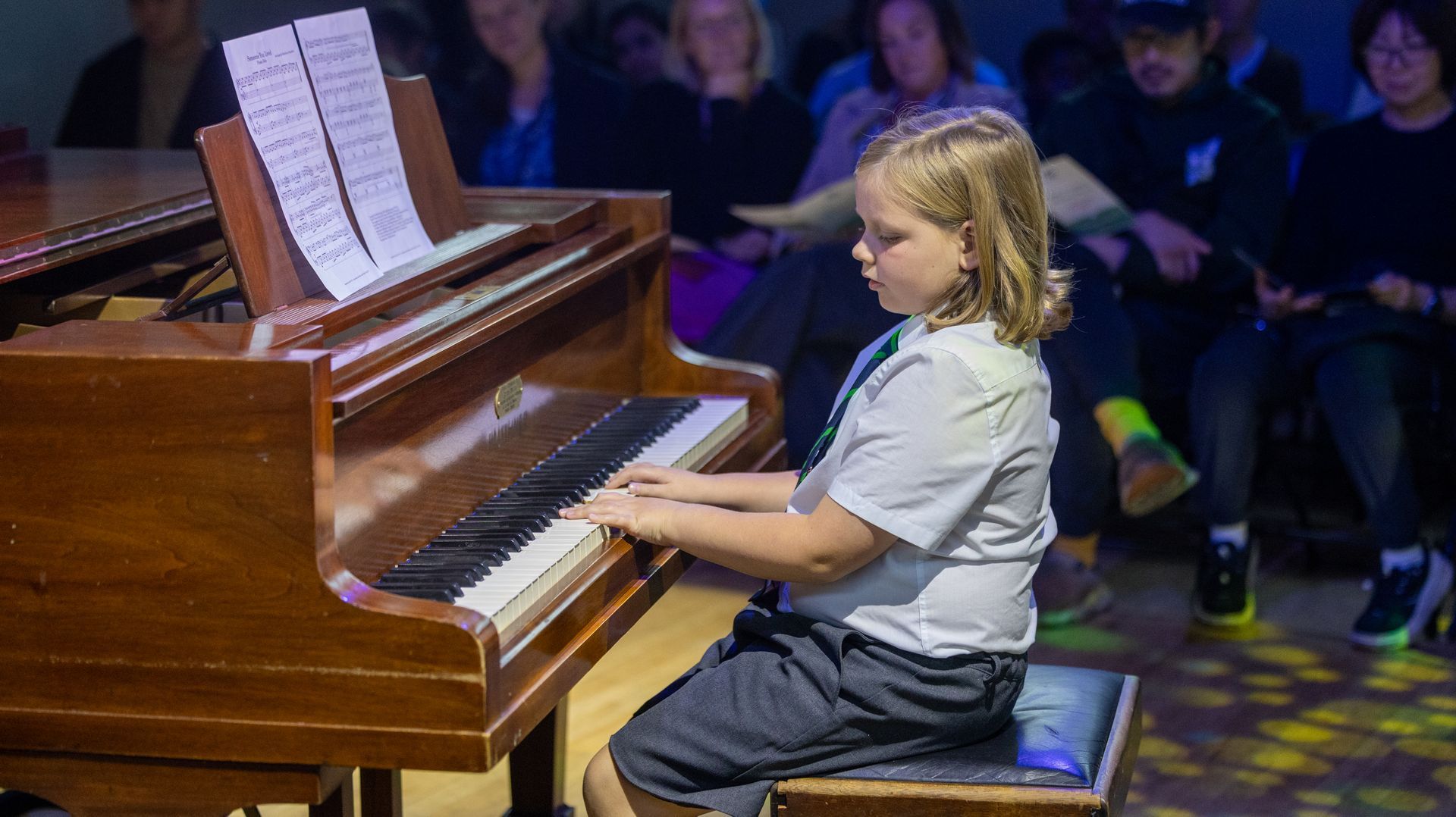
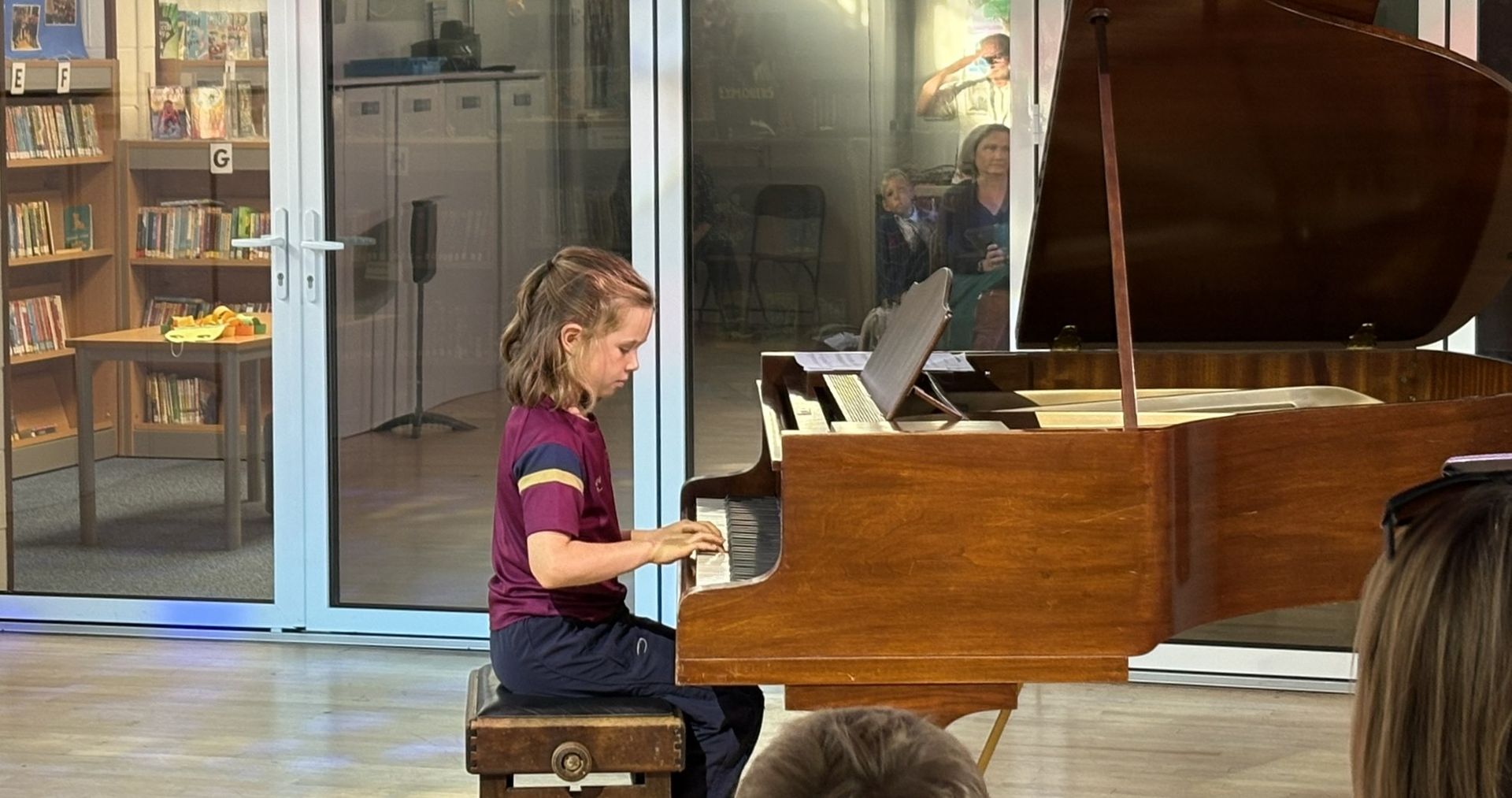
A warm Lower School Hall was alive with music, laughter, and a touch of theatrical flair as children from Lower 2 and Upper 2 took to the stage for a truly delightful concert last night. The evening opened with a confident piano performance of Rocking the Boat , quickly followed by the wonderfully imaginative The Dinosaurs Bedtime March , which had the audience picturing a parade of sleepy prehistoric creatures. The ever-popular Sun City by P. Wedgwood made several cheerful appearances throughout the programme, each performance bringing its own sparkle. There was elegance and poise in The Ballet Dancer , while a charming cello rendition of Gavotte by Gossec added a touch of classical sophistication. The audience was then treated to, I Love Coffee , which was delivered with great character and more than a hint of humour. Film fans in the room were delighted by a violin performance of Hedwig’s Theme by John Williams, transporting everyone straight into a world of magic. This was followed by more lively piano pieces, including the flowing The River Flows in You and the crisp Allegretto by Bartok. The energy lifted even further with Way Out West and The Machine , before a bold trumpet performance of the James Bond Theme by M. Norman had toes tapping and imaginations racing with spy adventures. The concert continued with the spirited Tarantella Twist on the piano and a relaxed guitar piece, Fingers and Thumbs by G. Whitworth. A light and playful flute performance of A Tisket A Tasket added a traditional touch, followed by more confident piano playing including Lightly Row and Le petit mendiant . One of the highlights of the evening was a lively vocal duet of The Lady is a Vamp by the Spice Girls, which brought plenty of smiles and a real sense of fun to the hall. Throughout the concert, the children showed not only their growing musical skills but also great courage and enthusiasm. It was a joy to see such a variety of instruments and styles on display, and the supportive audience created a wonderfully warm atmosphere. Well done to all performers for an entertaining and memorable afternoon of music and well done to all pupils in the Lower School who have showcased their musical instruments throughout the year. 
By Eleanor Lewis June 25, 2026
On Thursday 25 June, the hottest day of the year, the Lower 6 scholars had a day out in Cambridge. The focus of the day was "What are museums for?" and the magnificent Fitzwilliam Museum answered the question emphatically: "Museums offer air-conditioned respite in the face of sub-Saharan temperatures!" In face of quite arduous circumstances - the rising mercury meant that a number of galleries were closed - the scholars produced some brilliant presentations on Egyptian sarcophagi, pre-Raphaelite paintings and Assyrian reliefs. We all had a great day and though our activities were tinged with the sadness that this was Dr Farr's last gallop as Master of the Revels, the pupils viewed the day as a useful opportunity to develop skills that will be useful to them when it comes to the university admissions process next year.
By Eleanor Lewis June 24, 2026
This year, our Lower School pupils embraced an exciting opportunity to take part in not just one, but two competitions at the Royal Norfolk Show: the School Gardening Competition and the School Growing Competition. Their hard work, creativity and enthusiasm were truly rewarded, as pupils proudly brought home an incredible four gold medals! In the School Gardening competition, pupils from Lower One and Upper One were thrilled to be awarded a gold medal for their outstanding exhibit. Their entry featured a beautifully designed wheelbarrow display inspired by Beatrix Potter’s Mr McGregor’s garden, created in celebration of 160 years since Beatrix Potter’s birth. The imaginative design brought a miniature allotment to life, complete with a rustic potting shed, garden gate, wellington boots and beloved characters from the Peter Rabbit stories. Every element was thoughtfully crafted, resulting in a delightful and highly detailed scene. One of the standout features of the display was a stunning willow arch and gate, expertly created by the Upper One pupils and decorated with flowers and crocheted carrots. This eye-catching centrepiece captivated both judges and visitors alike. Four Upper One pupils also had the opportunity to speak with the judges, confidently explaining the inspiration behind their design and proudly showcasing their exhibit. The School Growing competition saw over forty pupils eagerly take part, nurturing their basil, calendula and radish plants at home with care and commitment in the weeks leading up to the Show. The best examples from each category were then selected and taken to the Showground, where they were judged against entries from other schools. Pupils were delighted to win all three categories which they entered. We are incredibly proud of our pupils for their creativity, perseverance and teamwork. The achievements are a testament to their enthusiasm and hard work, and we are absolutely delighted to celebrate the success of winning four gold medals at this year’s Royal Norfolk Show! Outdoor learning and gardening skills are interwoven throughout the Lower School curriculum, and our success at the Norfolk Show is a testament to this.
By Eleanor Lewis June 22, 2026
Last week our Infant pupils were delighted to welcome author and illustrator Ali Stearn for a truly memorable visit. Ali shared her heartwarming books, which were inspired by her miniature Shetland pony Jack Brock. Ali and Jack have made a real difference in Norfolk through fundraising and visiting residents in care homes. The children were captivated by Ali's engaging storytelling and entranced by the detail in her beautiful illustrations. They loved hearing about Jack's adventures, especially the amusing tales of his fondness for Victoria sponge cake and his habit of spitting small pieces of carrots on the care home floors while bringing smiles to patients and staff alike!  The highlight of the day was undoubtedly meeting Jack in person. Pupils were thrilled to have the opportunity to feed him carrots and see first-hand the gentle pony who inspired these wonderful stories. It was a magical experience that brought the book to life and helped our children understand the positive impact that kindness, compassion and animal companionship can have on others.
June 22, 2026
To set off Gather26 was the beloved Oliver! Jr. Rosie B, Lowe 6, writes her experience of being part of the backstage crew, and the production as a whole, below. On Monday the 15 and Tuesday the 16 June, the Fourth Form kicked off Gather 2026 with an exciting and uplifting production of Lionel Bart’s Oliver! Jr. Being an independent project, it was directed by Daisy S and Charlie Br in the Lower 6, who have been working incredibly hard behind the scenes to bring to life this fantastic show. Starting off the performance with ‘Food! Glorious Food!’ choreographed by Benji S, it was clear that the audience were in for a treat. Santiago O’D and Sampson O’F were compelling and funny as partners in crime, Fagin and Dodger, whilst Annabelle H as Nancy and Oliver PW as Oliver provided a deeply moving emotional core to the show. Not forgetting William M, terrifying as Bill Sykes! There are so many more performers I could name, each one clearly giving their everything and loving every minute of their performance. I also got the opportunity to help as backstage crew- it was astounding to see the professionalism of these young actors despite having to navigate costume crises and prop panics backstage! I look forward to seeing what they’ll do next year. Oliver! Jr was a brilliant performance that absolutely left the audience asking for “more”!
By Eleanor Lewis June 22, 2026
Upper 2 took to the stage this week with their fantastic production of Dragon Days , delivering a performance full of energy, comedy and wonderful singing. The children embraced every moment of the show, bringing their characters to life with confidence, enthusiasm and great humour. Their lively performances, combined with impressive vocals and excellent teamwork, kept audiences entertained throughout. It was clear how much the children enjoyed being part of the production, and their excitement shone through in every scene. From the catchy songs to the laugh-out-loud moments, Dragon Days was a tremendous success and a memorable experience for everyone involved. Congratulations to all of Upper 2 for their hard work, dedication and outstanding performances.
By Eleanor Lewis June 19, 2026
Cara B, Lower 6, represented England in their Under-19 squad at the European Korfball Championships in Türkiye. Cara shares her experience below. Over the Easter holidays, I had the incredible opportunity to represent England as part of the Under-19 squad at the European Korfball Championships in Turkey. Korfball is a mixed-gender team sport that originated in the Netherlands and combines elements of basketball and netball. Each team consists of four male and four female players, with players switching between attack and defence every two goals. The tournament began with group-stage fixtures against Czechia, Slovakia, Poland, Portugal and Hungary. Our opening match was against a strong Czech side, who went on to come second overall. Despite a determined effort, we were defeated 17-8 in our first game. However, we responded brilliantly later that day with a convincing 12-2 win over Slovakia. At the end of day 1, we remained in contention for a strong finish in the competition. Day 2 proved to be another challenging but rewarding day. We started with an impressive 13-8 win against Poland before facing Portugal in a crucial match. Despite our efforts, Portugal edged us out in a hard-fought 13-10 defeat at full time after a goal for goal match. We finished the day strongly with an excellent 23-14 victory over Hungary, one of our highest-scoring performances of the tournament. Going into the final day, we were determined to secure the highest possible placing. This set up a closely contested placement match against the host nation, Turkey. The game was highly competitive, with both teams going goal for goal for much of the match. We held our nerve in the closing stages to secure a 16-13 win, earning England a final placing of 5th in Europe. Cara's recent success at Korfball, has been mirrored by an outstanding performance on the netball court this season. Cara was a key member of the Norwich School 1 st VII who finished an impressive 11 th in the country this season, as well as representing her netball club, Norfolk United in the National Premier League, the highest club league in the country. Head of Netball, Gemma Ashton comments "Cara has made an immense contribution to Norwich School Netball since joining us in L6 and her considerable talent on court is matched by her dedication and commitment off it. Her success this season is fully deserved and we are very proud of all she has achieved. Cara is also a Norwich School Sport Scholar, and we are delighted that this programme was able to contribute towards funding her attendance at the Korfball European Championships."
By Eleanor Lewis June 19, 2026
(This assembly was delivered two days after England’s first world cup match of 2026, with a large England flag draped over the front of the pulpit.) God says: “ It is too small a thing for you to be my servant to restore the tribes of Jacob and bring back those of Israel I have kept. I will also make you a light for the Gentiles, that my salvation may reach to the ends of the earth .” (Isaiah 49:6) You may have noticed that I’ve decorated the pulpit this morning. I want to start by asking you this question: what was the first thing that went through your mind when you saw this England flag? Right now, of course, there’s a good chance that it reminded you of the England men’s football team, who kicked off their World Cup on Wednesday. Perhaps seeing this gave you a surge of national pride. (4-2: the first time we’ve scored that in a World Cup since 1966.) On the other hand, if you don’t think of this so much as your flag – for instance, if you’re from a different UK nation or from Europe – then this flag may stir feelings of rivalry. Context is everything. To see the flag flown on Windsor Castle on St George’s day in 2026 is very different to seeing the red cross on the front of crusader shields in the 13th century. Seeing the flag displayed on a church or a town hall is different to seeing it cable-tied to lampposts and painted on roundabouts. There was a spate of this a year ago which spread across the country. ‘Flagging’, as it became known, started in the month after the England Women’s football team won the Euros. (You may remember that moment of national pride – Chloe Kelly’s winning penalty, Hannah Hampton’s heroics in goal, Lucy Bronze somehow playing through the tournament with a fractured tibia. It’s just been announced that six members of that team will receive an MBE for their services to football and to the country.) Of course, all this meant that there were lots of England flags available to buy in the shops. And when they started going up in the streets, some people said it was patriotism. But it wasn’t just patriotism – there was also something more sinister and territorial going on. The context shifted, and the flags became associated with anti-immigration and extremist politics. All of that meant that, when I went into Home Bargains to buy this flag for my assembly, it felt like the shop staff were giving me funny looks. ‘What is he?’ they seemed to be asking themselves. ‘Is he an England fan… or is he a racist?’ There is a scene in the excellent TV drama Dear England, which is on iPlayer at the moment, where the then England manager Gareth Southgate hangs a St George’s flag in the goalmouth and gets all the players to discuss it. He begins by pointing at the flag and saying: ‘These things can be emotive and complicated.’ To get some perspective on all this complexity, I want to step away from England for a moment, and take note of a different nation in a different time – the Old Testament nation of Israel in the Bible. One of the developing themes of the Bible is what God’s chosen people think their nation is for. There are times where they retreat into self-isolation – they feel a need to pull up the drawbridge and protect their identity. But there are other times when they realise their blessings are for sharing with the world, rather than clinging onto. ‘It is too small a thing,’ God says to his people in that reading we heard earlier, it is too small a thing just to be concerned with the tribes of Israel. ‘I will also make you a light for the Gentiles, that my salvation may reach to the ends of the earth.’ In other words, the blessing that God’s people have is for spreading, not for desperately protecting. Christians believe that the ultimate expression of this is in the person of Jesus Christ, born a Jew, but a saviour for all peoples – the ‘salvation that reaches to the ends of the earth.’ Returning to England, I think we can learn something from our local heroine Edith Cavell, whose grave is outside the east end of the cathedral. She famously said before her wartime execution, ‘Patriotism is not enough. I must have no hatred or bitterness towards anyone.’ Perhaps we could adapt that line as: ‘Patriotism alone is too small a thing.’ No doubt the meaning of the England flag will continue to change as history unfolds. But here are my hopes for it. I hope that the current world cup tournament will reclaim the flag of St George from the tensions of last summer, and that it would help us feel united as a country, not divided. And I hope that as a country, we would discover generosity and hospitality towards other nations in the style of Isaiah 49. I hope we become the sort of country that is patriotic and outward-looking at the same time. In the end I want to live in a world where, when I buy a flag like this from Home Bargains, the staff think to themselves, ‘there goes a good person.'
By Eleanor Lewis June 19, 2026
Over the May half term, Lower Two pupil Dylan travelled to Kenya with his family and other volunteers to help with building work at the Jubilee Academy, Nakuru. The school was built in corrugated steel in 1998 to provide free schooling to local children. It was subsequently closed in 2019 when a new law was introduced that insisted that all schools should be made from brick. Undeterred, work started to rebuild the school. Currently, it is an infant school. However, due to the difficulty its pupils have in finding a school to attend once they have left, Jubilee Academy is committed to expanding to allow the children to continue their education. School can be the only place where children have a nutritious meal, so if they stay in school they have a greater likelihood of remaining healthy. Work had already started on building new classrooms, so Dylan helped to decorate them and worked on creating a new toilet block. During his rest periods he enjoyed playing football with the pupils there. Before the trip, he had called upon his year group to raise money to buy backpacks for the school in return for wearing Kenya's national flag colours for a day. Lower Two pupils were keen to do this and they also wrote letters to the children at Jubilee. Dylan's mother commented, "Seeing the children open the letters and see that someone has written them a letter just to them was priceless. I will remember their reactions for ever." Receiving replies from their Kenyan friends was equally exciting and fulfilling for our Lower Two pupils.  Dylan worked incredibly hard in Nakuru as the youngest volunteer the organisation had ever welcomed. Not only did he learn new practical skills in painting, plastering and carpentry, he gained new friends, and discovered that football really is a shared language across the world. His friends and teachers are proud of what he helped to achieve on his trip.
More Posts