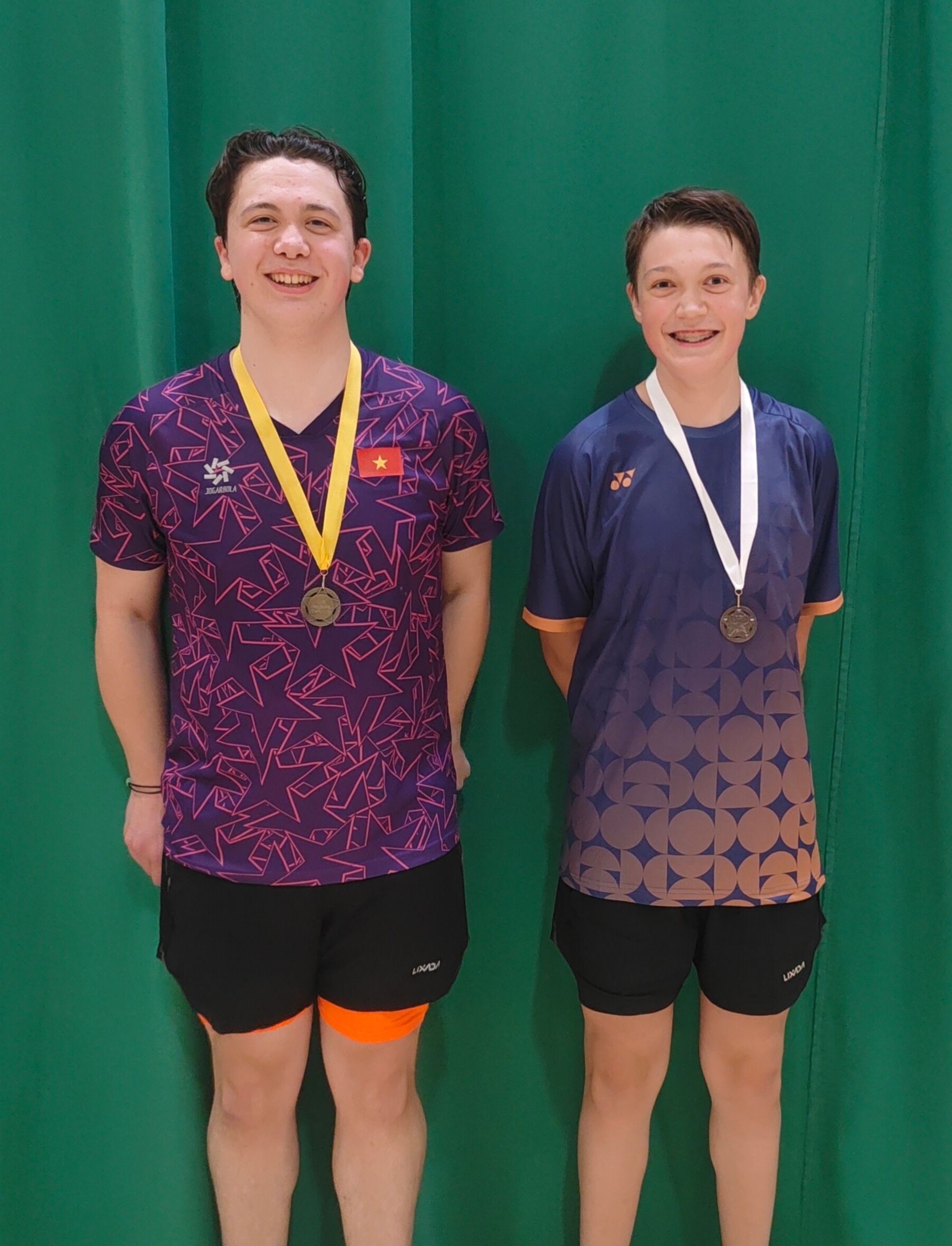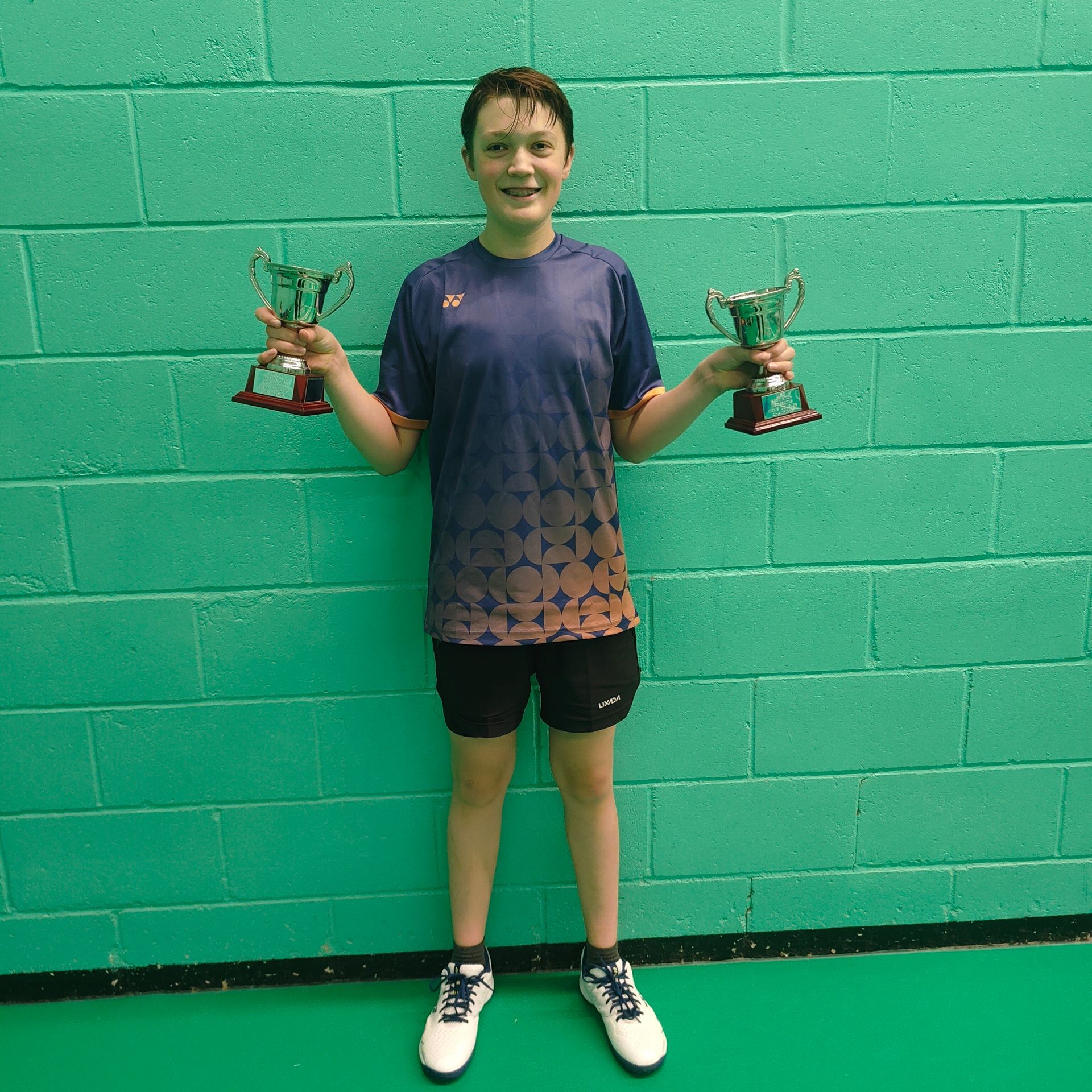
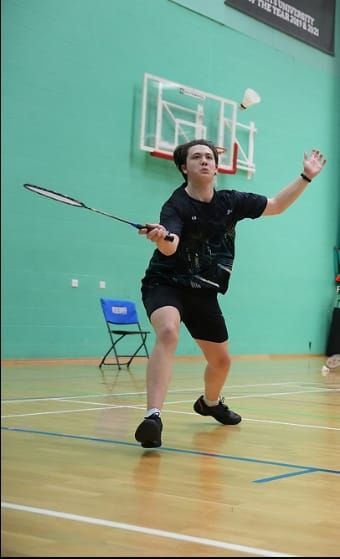
Brilliant Badminton - The Success of Brothers, Oren and Oscar

February 11, 2026

How long have you both been playing badminton? Did you start together? 


Oscar:  I’ve been playing badminton since I first watched it on the TV during the Commonwealth Games in 2014 and was transfixed. I asked my parents if I could try it so they found a local junior club and that was that - I’ve played ever since. It started out as playing once a week at the club, then I played more and more often before trialling for the Norfolk County squads and was very pleased to be selected. We both quickly graduated to the advanced sessions and were fortunate to get to play with older players which really helped us to develop our skills. I first represented Norfolk u18s when I was 12 which was very exciting, and I have been able to play all over the country. 


Oren: I watched a couple of Oscar’s sessions and also wanted to have a go, which probably annoyed him intensely. We were in different groups because I was only 4 years old and had to have a smaller racket, practicing with giant training shuttlecocks or balloons. We both used to play tennis and so our hand-eye coordination was already good which probably helped and I was able to improve quickly and joined him in the older group. Since then I’ve played more and more, and now I play as much as I can. We do spend a lot of time together training and playing, and he coaches as well so comes to venues to encourage and coach us during matches and tournaments. It’s nice that we have badminton in common and he can string my rackets for me and I don't have to pay him. 


Do you play with the school or outside the school?  Or both? 


Oscar: I have played with the school and helped run the sessions but there hasn’t been a structured programme which is a shame. Outside of school, I am too old for Junior County teams but I now play for the Senior County team and regularly coach the junior squads. I also represent Mid Norfolk in League 1 and Anglia Vikings in the Ultimate Badminton League which is a national team event. I’ve attended international training camps in Europe which have been really hard work but also great fun. The official badminton season runs from September to May so in the summer months we organise sessions to train and compete so that when the season starts again we aren’t rusty. 


Oren: I did get the chance to play a bit in the Lower School but unfortunately there is no Badminton provision any more for Inters. I would love to play at school though, I think it would encourage other people too. Outside of school I train with and play for 3 clubs, and I represent Tasburgh Men’s team in the adult League. I also play in the u17s and U19s County teams though I’m only 15 which is cool. I train a lot, usually around 15 hours a week plus matches and tournaments. This weekend I’ve had a league match after school on Friday, then a tournament in Oxford on Saturday and an U19s County match against Cambridgeshire on Sunday so it’s a lot of travel, training and playing but I love it. I often do a lot of my homework courtside or in the car because we’re always travelling for matches and training. 


What do you enjoy about it? 


Oscar: I really like that you can go to a club night and there is a wide range of playing standards from beginners to County and National players and it’s really inclusive. They also try to nurture those coming up through the junior clubs so that they have a great introduction to the adult game and a lot of support. The idea that I can go anywhere in the country, say for university or work, and can walk into a ready-made community is really valuable to me - it’s like a universal language. I like that it can be both a team sport and an individual one so you get the best of both worlds - teamwork, building relationships with your playing partners and also the challenge of playing singles and being responsible for your own performance; there’s nowhere to hide when it’s just you on court. You have to be really resilient and if you miss a point you can’t dwell on it because you have to focus on the next one. 


Oren: I like how fast and exciting the game can be; it’s the fastest sport in the world with the shuttlecock potentially being hit at 100s of km/h so you really need to think on your feet. At the same time it’s really tactical and you have a split second to assess where the shuttle is going, where your opponent/partner is and what shot you’re going to hit and this changes with each of the events i.e. tactics and gameplay is really different for mixed doubles compared to singles or open doubles. I think that the more you get into it, the more you realise how technical it is and you’re always learning new techniques and subtle differences in gameplay. Sometimes you think you’re really good and then you watch the next level up or international tournaments and you realise that there’s so much more to do and learn. I’ve been to tournaments to watch and enjoy going to the All England in Birmingham every year which is the world’s oldest tournament and is the one that all professional players want to win, a bit like Wimbledon. While I enjoy watching, I’d much rather be on court playing. 


Do you take part in any other sporting activities? 


Oscar: I used to play rugby but after being injured a few times and being unable to play badminton, I realised that badminton was the most important option for me. When the County training sessions were moved and clashed with rugby, the choice was an easy one. I used to play tennis and was invited to represent Norfolk. The problem was that I enjoyed playing but never felt the need to be competitive. Badminton is different for me and I do want to push myself, do better and win trophies and medals so it’s a very different mindset. As well as badminton training, I do Crossfit and go to the gym to maintain my fitness but there’s not a lot of time to fit in other sports, especially with A levels. 


Oren:  I really enjoyed playing tennis and played it alongside badminton for 5 or 6 years but as I progressed, both my tennis coaches and badminton coaches complained that each sport was interfering with the other. Although badminton and tennis seem similar at a superficial level , they are actually very different. When the time came, I chose to continue with badminton and I don’t regret it. Like Oscar, I had to give up rugby outside school to train with the County. I think my mum was quite pleased that she didn’t have to stand in the cold at a rugby or tennis match any more. I’ve got a personalised strength and conditioning programme from my coaches with movements and drills specifically for improving my footwork, agility and stamina. With this programme, training, playing and schoolwork there’s not much time left. 


Can you tell us about your recent successes? 


Oscar:  I’ve won 13 County championships at all age groups, and am reigning U19 County Champion in Mixed Doubles and Men’s Doubles adding to my previous title in the Men’s Singles. I have competed for Norfolk and coached at ICT (Intercounties Tournament - the premier national junior team competition) several times and helped achieve Norfolk’s highest ever result, as well as captaining the team to the Shires League finals, placing us in the top 8 counties in the country. I recently secured promotion to the top division of the Club League with my team. I also compete nationally and have had successes across the country, most recently at Christmas in my last u19s tournament.   


Oren:  I’ve recently won the Senior (Adults) Norfolk Moderates titles in both Men’s doubles and Mixed Doubles, and this weekend won the gold medal in the Men’s doubles at a National tournament near Oxford. I was 2nd in the u19s County Championship recently, only beaten by Oscar. I am no.1 in the U17 and U19s Junior County Men’s doubles and also have helped my team gain promotion in the Senior Club League. Last year I participated in a 24hr charity ‘Badmintonathon’ run by an ON and was one of the few players who lasted the full 24 hours. 


Where do you see your future in badminton? 


Oscar:  I’m hoping to compete in BUCS at University and am looking forward to experiencing the competitive programmes and structure that they can offer me. As part of my university options, I’m planning to travel to South East Asia where the badminton culture is very different and I think I can learn a lot there which really excites me. I’ve previously volunteered with Badminton England, working at Nationals and the Commonwealth Games, and was awarded the National Volunteer of the Year award so I would hope to continue being involved not only playing but in the running of the sport. I’m currently volunteering as a line judge with the National Badminton League which is great fun and I’d like to complete my Line Judging and Umpiring training with a view to travelling to international tournaments and matches in an official capacity. Working at the Commonwealth Games really opened my eyes to the power of collaboration and community in sport and was partly what attracted me to my chosen degree courses. I am also on the committee of Norfolk Badminton and coach the Junior County Squads regularly, as well as being on the Badminton England National Youth Forum so I would like to continue in those roles - I love playing but also enjoy the organisation and grass roots work to keep the sport accessible to as many people as possible. Badminton is also bringing some income to me as I’ve started my own stringing business and I’ve already managed to build a customer base which is great and will be helpful at University. I’m involved in badminton in many different ways and I can’t see that changing anytime soon. 


Oren:  I have 2 more years left of competing at ICT and so want to continue to be selected for that and to follow Oscar into the Senior County squad when I’m old enough. In the meantime, I want to compete in the national tournaments as much as possible and to continue representing Norfolk. I’m looking forward to doing my Badminton England Young Leaders qualification and also to do my Level 1 coaching qualification. I’ve had so much support from coaches and club members that it would be nice to be able to give back and encourage younger players. This summer I’m going to an international training camp in Denmark.  I’m a bit nervous because it’s pretty intense but I am looking forward to pushing myself. 


What would say to anyone interested in the sport? 


Oscar: Honestly, just give it a go. As well as being a great sport, there is so much scope to get involved at club and county levels. I know players at the clubs I go to who have been playing for 60+ years and are still loving it and love to play with the younger ones. There are lots of casual community groups that play locally - it doesn't have to be super competitive, but if you want to take it a step further there are many opportunities. It’s also never too late, I know people who started at my club a year or two ago and they now compete on the tournament circuit and are representing clubs. We went on holiday last year to Vietnam and it was amazing to see the culture of badminton in that part of the world. They have courts marked out on the streets, there are people playing at all times of the day and night and it’s open to everyone; I would love to see it so accessible in this country. 


Oren: Badminton is really fun at all levels, you can just book a court and turn up with your friends. Also the clubs are very supportive and social, you get to play with people of all levels. It’s really nice that there are ex-England players who are very happy to play with people who have only just picked up a racket. I think that schools should offer more opportunities to play as well, it’s one of those sports where you don’t have to be one of the traditionally sporty people to pick up a racket and hit a shuttle. I saw an article very recently about how the speed and unpredictability of Badminton can sharpen your brain, improve focus and boost cognitive ability so alongside fitness and social interaction there’s no reason to not give it a try. 


Photo credit - Alan Spink

By Eleanor Lewis April 30, 2026
2026 is National Year of Reading and we are going all in here at Norwich School! We know reading expands worlds, sharpens minds, and fuels creativity, so let's get inspired! Every month we are focusing on a different genre and hearing from a member of staff about what they like to read, why, when and where! Next up we have Crime Fiction for April and a huge fan of this genre, Gillian Wright, Lower School Teacher, is going to tell us a bit about why she loves Crime Fiction so much! Tell us a little bit about the genre; what common themes or elements do you particularly enjoy? I enjoy delving into stories that revolve around secret missions, missing persons, or even a mysterious killer. The suspense, unexpected twists, and deductive reasoning keep me eagerly turning pages until the inevitable surprise ending. These books are often packed with action and clever plotlines that keep readers guessing right up to the final chapter. The most thought-provoking stories are those rooted in real-life situations that readers can relate to, such as The London Eye Mystery by Siobhan Dowd. I also enjoy books that take me out of my comfort zone and offer different perspectives on the world, for example T he Hunger Games by Suzanne Collins. What was the book that introduced you to crime fiction? Was there a particular book or author that made you fall in love with this genre? The book that first sparked my interest in reading was James and the Giant Peach by Roald Dahl. Although it is not a classic crime novel, it is certainly an exciting and mysterious adventure. Aunt Sponge and Aunt Spiker clearly display some questionable—if not criminal—behaviour. I suppose my first real exposure to crime fiction came through The Famous Five adventures by Enid Blyton. I loved seeing how a group of children worked together to solve mysteries without any adult help. From that point on, I have always been drawn to stories filled with adventure, mystery, and unexpected twists. I also enjoy a touch of dark humour, which is why I thoroughly enjoyed A Series of Unfortunate Events by Lemony Snicket. The books are grim, funny, and strangely addictive. Has your taste in this genre changed over time? No, my taste for crime novels has not changed. Although I do enjoy a good historical novel, I will always return to mysteries and crime as they provide intrigue, twists and those quiet ‘aha’ moments. Most recently, I have enjoyed The Thursday Murder Club mysteries by Richard Osman. Would you recommend this genre to someone who doesn’t usually read it? Why? There is something timeless about a good mystery. It isn’t just about solving crimes or catching the villain; it’s about asking questions, noticing subtle details, and thinking more deeply. In a world dominated by quick scrolling and short attention spans, mystery novels remind us that it’s okay to slow down, immerse ourselves in a story, and truly pay attention. What do you enjoy most about reading, whether crime fiction or anything else? Reading is essential to me; it allows me to step away from the busyness of everyday life and escape into magical and mysterious worlds, while also enabling me to explore new perspectives. Books have the power to evoke a wide range of emotions, from joy and excitement to sadness and tension. I love immersing myself in a new story—being drawn along with the characters, seeing the world through their eyes, and allowing the words to take me on a journey. When and where is your favourite time and place to read?/ Do you have a favourite reading spot or routine for diving into books? I read every night before I go to sleep, as it helps me wind down after a busy day and fully relax. On sunny days, I especially enjoy reading outdoors, whether that’s in the garden or by the pool while on holiday. Which fictional character would you most like to have a cup of tea with? I would love to share a cup of tea with Willy Wonka, as he would likely provide an unusual combination of flavours—perhaps even with a side order of chocolate. Do you tend to reread favourites from this genre or always look for something new? I don’t usually re-read books, although I have returned to Roald Dahl’s stories time and again—mainly to allow my children to experience the joy of his imaginative and magical tales. When was the last time a book from this genre really surprised you? The essence of a good crime or mystery novel is its ability to surprise the reader, and they never fail to leave me guessing. I have never yet managed to work out the final twist of a truly good crime novel. Do you prefer classic or modern books within this genre, and why? I enjoy both. A classic tale by Agatha Christie or a mystery involving Sherlock Holmes is always enjoyable. However, more recent authors, particularly for children, have created some new classics, such as the Alex Rider series by Anthony Horowitz or Murder Most Unladylike by Robin Stevens. Has your taste in books changed over the years? I used to enjoy reading the classics including books by Thomas Hardy and EM Forster. Nowadays, I prefer a lighter read intermingled with more challenging stories. I am always up for a good book recommendation. Why do you think reading is important? Reading for enjoyment can spark the imagination, provide an escape, and inspire creativity. It offers a way to discover new worlds, meet new characters, and learn about the past. Above all, it is an easy, enjoyable, and relaxing way to spend time. If you could step into the world of any book, which would it be and why? If I could step into the world of any book, it would probably be Harry Potter . The incredible creatures, magical adventures, friendships and rivalries, along with the mysteries waiting to be solved, all combine to make these stories so captivating. I would love to try my hand at a few magic spells myself. Having visited the Warner Bros. Studio where Harry Potter was filmed, it was amazing to see the sets and costumes used by the characters. It truly brought the stories to life and felt like a real privilege Click here to see the monthly Reading List!
By Eleanor Lewis April 30, 2026
The 2026 Norfolk Primary Maths Challenges, hosted by Norwich School, were brilliant days all round, bringing together some of the strongest young mathematicians from across the county for a fun and friendly competition. There were three rounds to tackle—Tangrams, Arithmetic, and lateral thinking—so plenty of variety to keep everyone on their toes. From quick calculations to tricky puzzles and creative challenges, pupils really got stuck in. It was especially impressive seeing such talented mathematicians working so well in their pairs, sharing ideas and supporting each other throughout. The atmosphere throughout both competitions was fantastic. There was loads of creative thinking on show, and just as importantly, plenty of smiles. Alongside the competition, many pupils had the chance to meet others from different schools, make new friends, and enjoy putting their maths skills to the test in a relaxed and encouraging environment. A huge congratulations to everyone who took part—you should be really proud of yourselves. And of course, well done to our winners: Year 5 Primary Maths Challenge Winners: 1st: White Woman Lane Junior School 2nd: Norwich Lower School 3rd: St Nicholas Priory Primary School Year 6 Primary Maths Challenge Winners: 1st: Norwich Lower School 2nd: Cringleford CE VA Primary School 3rd: White Woman Lane Junior School Well done again to everyone involved—it was a great day and we’re already looking forward to next year!
By Eleanor Lewis April 24, 2026
My talk this morning is inspired by some words that were used in assembly on Wednesday, particularly with the public exam year groups in mind: ‘You will always be part of our school’s story’. It’s absolutely true that school isn’t just a place, or an organisation, or a list of names. School is a story – a story we’re continually creating. Our story-making at this time of year includes things like taking a whole-school photograph, a snapshot of all the people that make up our community at this particular moment. For the Upper 6, it includes contributing to the Leavers’ Yearbook, where you share your memories and anecdotes. It includes holding dinners and special services where we remember our achievements, the unexpected twists we had to navigate, and how the story of the year has unfolded. We do all this because our stories are an important part of our community. Another thing that communities often do with stories is to take an inspiring narrative and make it our own. In Cathedral Close we do that with Nelson, with Edith Cavell, with Julian of Norwich and St Benedict, all of whom have monuments to remind us of their stories. And I want to mention three other stories that, whether we realise it or not, have become part of our culture and therefore part of us. Yesterday was St George’s Day. You may be only vaguely aware of the story of England’s patron saint – that’s true for many people. But you probably remember enough to know that St George was brave; that he faced the fight against the dragon while everyone else feared and fled. Just to be aware of the tale is to have before you an ideal of courage and standing up to adversity. That’s why St George has become one of our foundational stories. The second story is, in a way, a Biblical version of St George: the story of David and Goliath. Goliath is the towering brute who has no care for anything or anyone. David is barely out of shorts – but he is plucky and he is faithful and his slingshot skills (from his time as a shepherd boy) allow him to fell the giant. If you know that much, then you’ll carry the message of the story with you. You may be young, you may be unknown, you may be inexperienced, but if you’re bold and you’re faithful, who knows what you might achieve. And if we know about David the giant-killer, we will notice when someone like Greta Thunberg publishes a book called No One Is Too Small to Make a Difference; and our ears will prick up when someone like Malala Yousafzai finishes a speech with the words, “One child, one teacher, one book and one pen can change the world.” The third story is the one that causes cathedrals like this to be built. It is the Easter story that is always told at this time of year. It is the story of someone who took on a spiritual battle, because this person’s resistance (unlike in the first two stories) was consciously non-violent. It is the story of someone who faced the powers of death and darkness alone while everyone else feared and fled. It is the story of someone who, out of love, went to the cross. It is the story of someone who death could not defeat, as his disciples began to realise on the very first Easter morning. If you know the story of Jesus, along with the story of St George and David, then you will have ideas about courage, and faithfulness, and things worth fighting for, that one way or another you will want to incorporate into your story, as the story of your life continues.
By Eleanor Lewis April 23, 2026
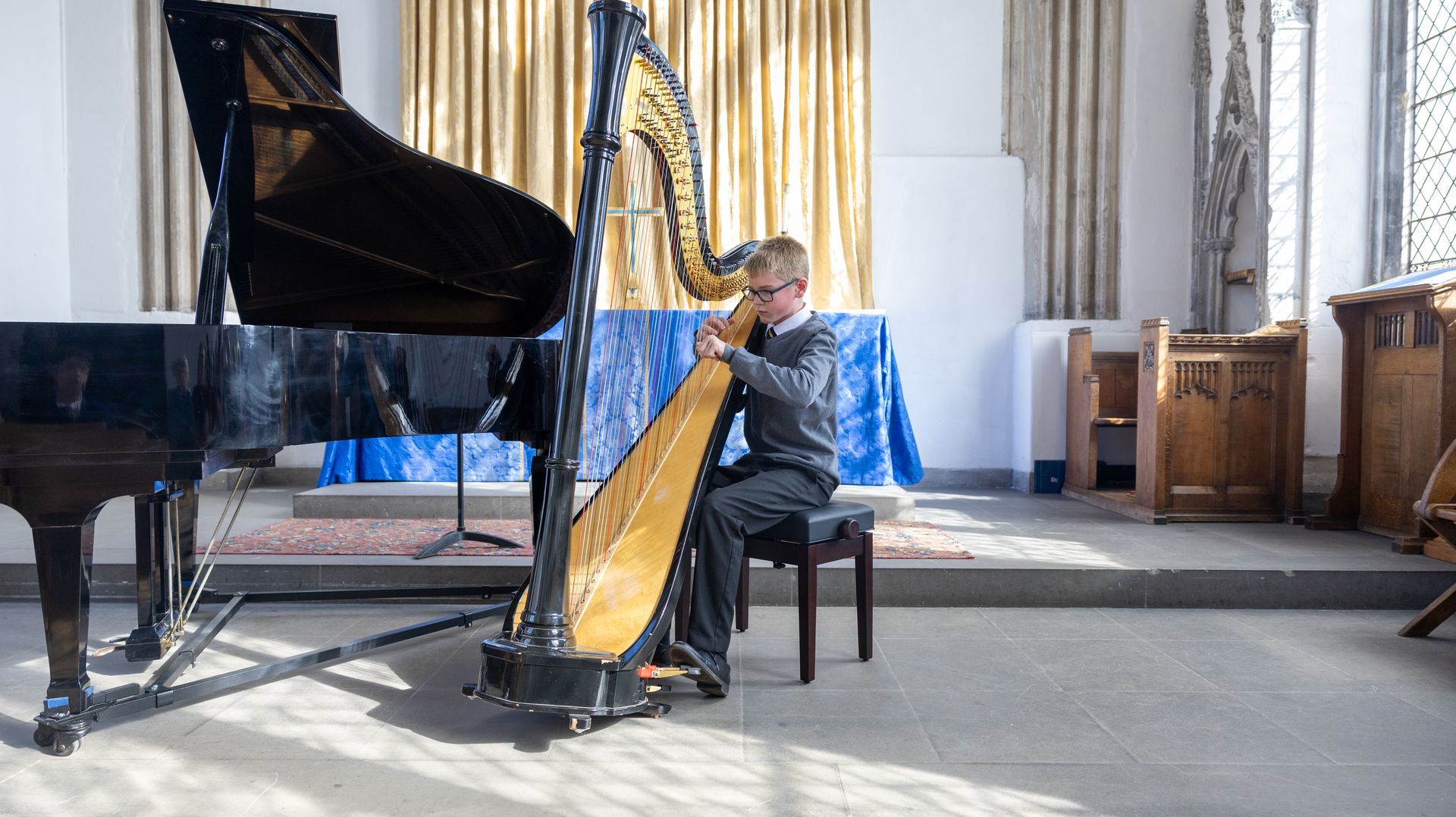
On Thursday 23 April, we were delighted to welcome back musical director Francis Goodhand to Norwich School for the second of his two musical theatre workshops for Music Award holders, as part of the Making Musicians programme. Evie A (M5) writes: “The workshop with Francis Goodhand was an amazing experience. He was incredibly kind and encouraging to every pupil, whether they were performing or watching from the audience. Each of us sang a musical theatre piece, after which Francis offered helpful advice on how to strengthen our acting through song before we performed it again. I really enjoyed watching the other pupils and seeing how Francis helped take their performances to the next level. I also greatly appreciated the feedback and practical tips he gave me to improve my own performance. Thank you so much to Mrs Speca for providing this opportunity.” Francis Goodhand commented: “I was so impressed with everyone’s preparation, as well as their singing, their ability to act through song, and their willingness to try new things.” Our thanks go to Francis for such an inspiring and enjoyable afternoon, to Simon Kenworthy Robbins for his sensitive accompaniment, and to all the pupils who took part so wholeheartedly and with such confidence. You can listen to their vocal warm up below (that they learnt in only 5 minutes).
By Sonja Mitchell April 23, 2026
Josh and George are fundraising for Unicef, and the cycling world tour is almost over. Join them for the final leg to Halvergate to celebrate this momentous achievement.
By Eleanor Lewis April 23, 2026
The international university fair offered our pupils some valuable exposure to a wide range of global education opportunities. We were fortunate enough to work with our long-standing partners – the University Guys – to welcome 5 global universities to Norwich School during period 5 and lunch on Monday April 20. The lunchtime fair allowed our pupils to interact directly with representatives from leading global universities namely, the Università Cattolica del Sacro Cuore offering medicine, business and other courses in English from Italy, Rollins (Florida) – one of the best small liberal arts colleges in the US, SCAD from Savannah in Georgia (the US’s largest art school) and TETR College of Business with its unique programme spanning 10 countries. From talking one to one with the different university reps, our students got accurate and up-to-date information about courses, how to apply and they could also learn more about and campus life overseas. It was also a great opportunity for Mrs Warren, the school’s Head of UCAS and Mr Sims to find out more about opportunities overseas and to build their own connections. We believe as a school that it is important to make the idea of studying abroad feel more accessible and less intimidating as well as wanting to broaden our pupils’ perspectives and ambitions. These fairs can also encourage early planning as well as motivating students to think seriously about their future pathways and the qualifications they may need. At Norwich School, we know the importance of inspiring confidence, supporting informed decision-making and opening doors to new opportunities which pupils might not have otherwise considered. If pupils who weren’t able to attend would like some more information about any of these universities, then please contact Mr Croston.
By Eleanor Lewis April 23, 2026
Welcome back – I hope you have a good break and are feeling energized for the final term of the year ahead. As ever, the weeks that lie before us fall into two distinct categories: first there is the rigour and discipline of drawing course material together as we prepare for assessments, whether external or internal; second is the joy of exploring opportunities in the post-exam period towards the end of term. My main advice as you approach the term is to make a connection between the two parts of term by establishing a routine that allows you make the most of both. Creating habits or behaviours that work for you are crucial. Keep balancing your academic focus with time to relax, particularly through physical activity and a strong sleep routine. Keep a sense of purpose in each activity; certainly be clear on what you are trying to achieve when you sit down for a session of revision and how it fits into your overall plans, but also be clear on the times when you want to get away from work, whether by organized co-curricular activities here at school or your own pursuits. Feeling guilty for not working is emotionally draining and should be avoided: either work or give yourself permission to have a break from work. Overall, you cannot control outcomes but you can control the process and, if you can be proud of what you have done to prepare, there is every chance that you will achieve your academic goals; even if you do not achieve them, you are likely to be able to accept the outcome because you gave a good account of yourself in the build-up. No short cuts, just solid, honest preparation. If you are struggling with this, let us know so that we can help to get you back on the right path. Good luck to you all! Another dimension in this process is perspective; no matter how much you want those grades or that mark, how you conduct yourself during the process and what you are establishing for yourself in terms of personal and shared values will always be more important for me than any particular score. Love, compassion and inclusion are key; nor should they be taken for granted, whether by you as individuals, by us all as a school, or indeed further afield because of the fact that we happen to live in a democratic country. The Varieties of Democracy Institute based at the University of Gothenburg in Sweden conducts an annual survey of the state of government around the globe. It found that 72 percent of the world's population now lives in autocracies – the highest level since 1978. In 2024, 45 countries were moving toward more autocratic government across the globe. In these nations, the patterns were similar – erosions in areas such as: freedom of speech, open elections, the rule of law, judicial independence, civil society and academic freedom. Governments expanded their power over institutions and individuals. It didn't happen in the same order or at the same speed, but in the end the destination was the same. My point is that people in the United Kingdom should be sensitive to the fact that so many other people on the planet have daily routines in political systems very different from our own. This divergence can be translated into the digital sphere, too, with the proliferation of extreme content making it increasingly possible for adversarial and hostile exchanges to take place because people see the world so differently. I am sure many of you have seen or have been made aware of the recent Louis Theroux documentary, Inside the Manosphere . This has brought to the attention of a wider audience the strength and extremity of opinions being expressed by the influencers profiled and others like them. For me, it was not so much what they said, it was their popularity and the implied normalisation of what were undoubtedly extreme views. For clarity, at Norwich School I expect the values of love, compassion and inclusion to be applied equally to every single member of our community, regardless of their sex and sexual orientation. Part of this is practical: we are bound in the UK by The Equality Act and it is an offence to discriminate against protected characteristics such as race, religion, age, disability and, for our focus today, sex. If we as a school and you as individuals get this wrong, there will be consequences. However, for me respectful treatment of others is more profound than that: whether it is the biblical advice of loving one’s neighbour as oneself, the principle of a PSHE classroom to have unconditional positive regard, or our school’s values of love, compassion and inclusion, I want each of you to brighten rather than undermine the day of those around you through your conduct. There are a number of possible challenges to the views espoused in the Theroux documentary, but one is the general “othering” and alienation of one sex by the other: men like this; women don’t like that. It has always been a staple of prejudice to establish dislike of a group of people through clumsy and inaccurate stereotypes which preclude a need for greater understanding. Indeed, one of the most chilling aspects of the documentary was the increasing use of antisemitism used by manosphere influencers to explain global financial inequities. That sort of stereotyping is harder to do when “the other” are real individuals alongside you in the same school community. As soon as someone tries to say, “Girls are like this and boys are like that,” it would be easy to identify members of our community who differ from such stereotypes: “That’s not what she likes and that’s not what he is like”. When you talk to any one of our pupils, whether male or female, you will get an individual with their own talents, interests and aspirations. For me, the manosphere influencers are wrong and I feel lucky that I work in a community every day that can show why. If anybody wants to talk to me about these issues in our community’s context, I am more than happy to do so. As you know, I am available to see any pupil from 8.15am on any morning except Tuesdays. I believe it is one of the great privileges of being in a co-educational setting that boys and girls get to practise appropriate behaviour with and around each other every day, reflecting on what works and learning from less successful interactions. I am determined that this community uses its privilege to create an appropriately safe environment to discuss these challenging issues in positive fashion. As you get started on this term, remember to establish routines that can cope equally with periods of academic revision, other activities and rest. And in all of this, remain true to the values that are at the heart of what we do here: be kind and positive to those around you, noting the injunction of our bible reading: “Let us consider how we may spur one another on toward love and good deeds, not giving up meeting together…but encouraging one another…” Have a great Summer Term!
By Eleanor Lewis April 23, 2026
Ian Hayward may have retired from Norwich School in September 2025, but he isn’t slowing down just yet. Ian is embarking on a new adventure, taking on one of Britain’s toughest endurance challenges: a full circumnavigation of mainland Britain by sea kayak. Ian, 58, plans to depart from Lowestoft in late April 2026, aiming to paddle more than 4,000 kilometres around the British coastline in a journey expected to take four to five months. The expedition, titled “Britain by Kayak 2026”, will see Ian navigate some of the UK’s most demanding coastal waters — including tidal races, exposed headlands and remote stretches of shoreline — entirely under his own power. A highly experienced outdoor leader and kayaker, Ian lead the 8th Norwich Sea Scouts from 2012 to 2022 and was Housemaster of Nelson House before taking of the role of Director of Sport until he retired in 2025. He has spent the past year preparing both physically and mentally for the challenge. His training has included long-distance paddling, endurance conditioning and expedition testing in both the UK and Spain. “I don’t need to be ready to complete the whole journey on day one,” Ian says. “I just need to be ready to start. The rest is about adapting, learning and making good decisions in a constantly changing environment.” The expedition is as much about mindset and resilience as it is about endurance. Ian reflects openly on lessons learned during training — including managing fatigue, reassessing risk after difficult surf conditions, and refining equipment, safety and communication systems. Alongside the physical challenge, Ian is supporting two charities — Movember and Surfers Against Sewage — raising awareness around men’s health and environmental issues affecting Britain’s coastal waters. He also hopes to spend time listening to the people who live and work around the coastline, capturing their experiences, hopes and concerns. While he will be paddling solo and mostly camping around the coast, Ian will gladly accept any offer of land-based support in the form of a cheery wave, cup of team or offer of accommodation. So if you think you can help or know someone that could, do please get in touch with Ian. The expedition will be documented through his “GooseJuice Adventures” platform, with regular updates, live tracking and video content shared online.  Ian remains connected to the school through his continued support of the 8th Norwich Sea Scouts and the School’s Duke of Edinburgh’s Award expedition programme.
By Sonja Mitchell April 20, 2026
FONS has purchased flag pins to celebrate the range of languages spoken within our community.
By Eleanor Lewis April 19, 2026
Bronze and Silver - Will Brown In early 2023, a group of 7 8th Norwich scouts and Norwich School pupils began their DofE journey, starting with bronze. They completed the practice expedition at the Norfolk Broads Yacht Club in Wroxham, helping develop their flat-water canoeing skills and giving them invaluable kit-packing and camping experience. The qualifying expedition on the river Waveney also proved useful, helping the group further develop their paddling and navigational skills, particularly through challenging sections of the river, such as those with foliage blocking the river. The group also dealt with their first capsize of the journey, which was handled well. Upon the completion of their bronze, 4 of the group – Oli, Hamish, Hector and Will – continued to Silver, which saw them complete their practice on the river Stour in Ipswich in early 2024. This was another step up for the group, with cold, wet and windy weather conditions making the paddle challenging. However, the boys pulled through, gaining experience paddling on the estuary, as well as setting up camp in the dark. This was followed up by many sessions on the water in Norwich, where white-water skills were developed in preparation for the 4-day qualifying expedition on the River Wye, in Wales. This was an incredible trip, with the group confidently navigating many sections of rapids along the river, most notably the Symonds Yat rapids. Fast Forward to 2025/2026 Gold Gold - Oli Clark In early April, Norwich School sixth formers and 8th Norwich Explorers, Oli, Hamish, Will, Hector and Adam completed their Gold D of E expedition canoeing the River Spey from Aviemore to Spey Bay, a distance of just under 100km along one of the most beautiful and challenging rivers in the UK. This was the culmination of years of developing canoeing skills under the guidance of Ian and Tim. The expedition was a fantastic experience, not only the challenge of canoeing down rapids such as the ominously sounding Washing Machine (which was actually quite tame), but also wild camping in some totally stunning places such as Knockando – where we also helped a fisherman rescue his dog which had got caught in the fast flowing water. The Scottish scenery was spectacular, in particular the amazing view of the snowy Cairngorms and we were fortunate to see some some pretty special wildlife on the way, like an osprey in full flight – although sadly no Golden Eagle despite our best efforts to spot one. We certainly learnt a great deal about paddling, from how to pack boats effectively to following the best line down rapids avoiding rocks and wave trains, and the experience has fuelled our confidence and desire to take on even more challenging rivers such as the Tryweryn in northern Wales. We would all without a shadow of doubt recommend others to take on canoeing for DofE, we are all lucky to have had such an incredible experience. We would all like to thank Ian and Tim for giving so freely of their time and being such incredibly supportive paddling role models- we also all wish Ian the best of luck for his Britain by Kayak challenge.
More Posts